Construction AI Brief
Construction AI: the millwork estimate that drafts itself, and the EU deadline that only half moved
MillworkSuite launched a tool on 22 August that reads a set of PDF drawings, prices the scope and pushes it straight into CAD as positioned cabinets. And the EU quietly moved its big AI deadline to 2027, but left the labelling duty biting from 2 August. Both land on the same person: the one confirming the number before it becomes a bid.
AI-assistedPrepared with AI assistance and human editorial review.
Today’s context: This brief covers the latest movements in AI tooling, adoption and signals for construction teams. Read on for what matters and what to focus on.
Tools & Platforms - Featured
The millwork estimate now drafts itself, and that tells you where the value really sits
MillworkSuite launched its AI estimating and direct-to-CAD platform on 22 August 2026, aimed at millwork and casework shops. What it does is read a set of PDF architectural drawings, return a priced scope of work, and then push that same scope into HOMAG iX, Microvellum or CabinetVision as cabinet layouts already positioned on the wall. Uppers, bases, countertops, vanities, toe kicks, soffits, and the drafting logic behind them. Sizes you adjust while estimating carry through to CAD, so a unit arrives at the width and depth you confirmed, not a round number someone typed twice. SMI Cabinetry, an early user, says it cut its drafting time in half. That's a vendor-reported figure, and I'd want to watch it survive a messy set of tender drawings before I put a number on it, but the shape of the thing is real. The company's showing it at the International Woodworking Fair in Atlanta from 25 to 28 August, so it's a live product, not a slide.
Now, on our own test, this isn't challenger construction software, the broad AI-first platforms taking on the big incumbents. It does one job, estimating and drafting for one trade, and it does it well. That's a point solution, and it belongs here in Tools and Platforms, not in a Challenger Watch. Worth being precise about, because the category only means anything if we don't hang it on everything that ships with the letters A and I.
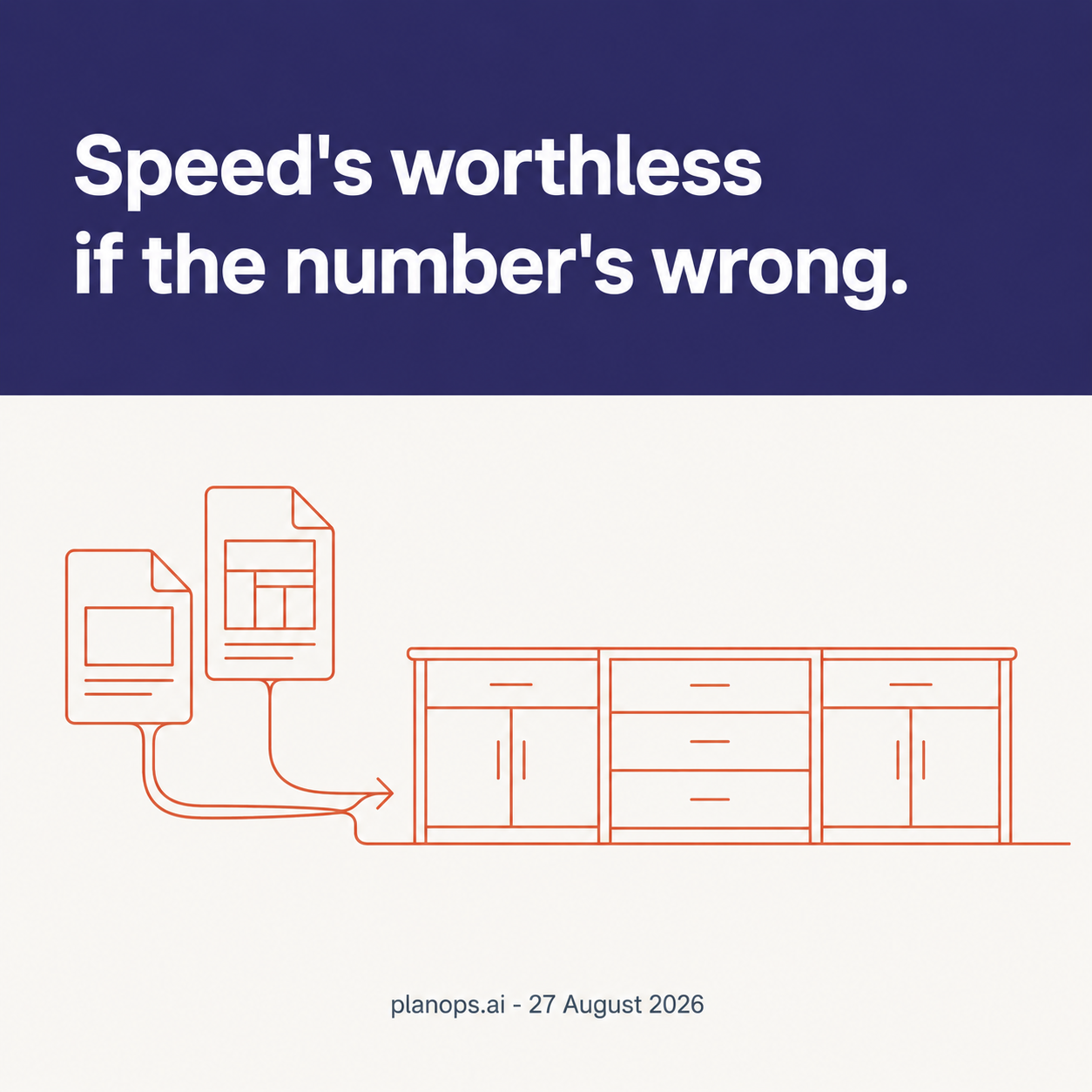
But the reason it earns the lead is what it says about where AI actually pays this year. Not the robot on the showreel. The estimate that redraws itself. A joinery estimator spends real hours turning a priced take-off back into shop drawings, by hand, work that's already been done once in the pricing. Collapse that, keep the estimator checking rather than redrawing, and you've handed a small shop an afternoon back every week. Speed's worthless if the number's wrong, so the check stays. The drudgery goes. That's the trade worth making.
Government & Policy
Brussels moved the big AI deadline, but not the bit that touches your drawings
Here's the one that'll get misreported all week. The EU has deferred the AI Act's headline obligations for high-risk systems. Under the Digital Omnibus, Regulation (EU) 2026/1744, published in the Official Journal on 24 July and in force from 27 July, the compliance date for standalone high-risk AI (the Annex III list) moved from 2 August 2026 out to 2 December 2027, and for AI embedded in products already under EU product-safety law to August 2028. Sixteen months of breathing room, prompted by member states not having their competent authorities or harmonised standards ready in time. So far, so much of a relief.
But read the small print, because not everything moved. The Article 50 transparency obligations, the duty to tell people when they're dealing with AI-generated content, applied on 2 August 2026 exactly as scheduled. So the headline "the EU delayed the AI Act" is half true and, if you act on it, dangerous. For a UK firm the relevance is direct: if you're a practice or a vendor selling AI tools into the EU, or producing AI-generated drawings, models or reports for a European project, the labelling duty is live now. The heavy conformity-assessment machinery is what slipped, not the honesty-about-provenance bit. Get that the wrong way round and you've relaxed on the deadline that actually arrived.
The comparison only goes so far, but it's the difference between the MOT being pushed back and the requirement to have working headlights being pushed back. One moved. One didn't. Check which is which before your compliance lead tells the board there's nothing to do until 2027.
Adoption & Evidence
The value's at the task edge, the discipline's in the labelling
Put the two together and you get the whole year in miniature. One end, a tool that quietly takes the drafting off an estimator and hands it back for a check. Other end, a rule that says whatever the machine produces, you tell people a machine produced it. Value at the task edge, discipline in the provenance. That's not a tension. It's the same job seen from two ends.
And it's worth remembering how few firms have actually crossed from trying to using. RICS's 18 August report put regular AI use in UK construction at 19%, against 29% in commercial property, with the same 39% of both stuck running pilots. So the sector isn't short of proofs of concept. It's short of workflows that made it into daily use and stayed there. A millwork tool that drafts, or a records tool that fills in a form, is worth more than another pilot precisely because someone's using it on Monday morning without being asked.
The procurement filter: before you buy any AI that produces a priced scope, a drawing or a report, ask the vendor two things. Does the output carry a clear marker that it's AI-generated, and does a named person confirm it before it leaves the building? If either answer is fuzzy, you're buying speed without a brake.
What matters most
- →If you buy an estimating tool that also drafts, make a named person confirm the priced scope before it becomes a bid. Speed's worthless if the number's wrong.
- →Selling or producing AI-generated drawings and reports for EU projects? Check they're labelled as AI output. That duty applied from 2 August, deadline shift or not.
- →Chase the pilot-to-production gap, not another pilot. The value is one workflow in daily use, not ten proofs of concept sitting in a folder.
Ready to put AI to work on your projects?
50 free Intelligence Units. Set up your first project in under 20 minutes. No credit card needed.
Get 50 free Intelligence UnitsGet the brief by email
Daily practical AI insight for construction teams. What changed, why it matters, and what to ignore.
50 free Intelligence Units - automate your programme admin
Why PlanOps publishes this
We help construction teams turn AI into useful work, not noise. Understanding what’s changing in AI is the first step. Making it work on-site is the real difference.
Found this useful? Share it.