Construction AI Brief
Construction AI: Bain put a $6 trillion price on the AI build-out, and the models doing the grunt work got about ten times cheaper
Bain reckons the data centres going up for AI will cost $5tn to $6.5tn by 2030, and that the whole AI business would need to clear roughly $6 trillion a year in revenue by 2031 to pay for them. On 8 October a Bain partner spelled out for Construction Dive what that means on the ground, that power and electricians, not chips, are what choke the build. The same week Anthropic cut the price of its small Claude model by about 90 per cent, which quietly changes the sums on every AI feature buried in the tools your team already opens.
AI-assistedPrepared with AI assistance and human editorial review.
Today’s context: This brief covers the latest movements in AI tooling, adoption, and signals for construction teams. Read on for what matters and what to focus on.
Industry Readiness: the bill for the boom (featured)
Bain put a $6 trillion price on the AI build-out, and told construction what actually chokes it
So the data-centre boom has been the one bright corner of UK construction all year. Civils and the hyperscale build-out did most of the lifting in the September PMI, housing stayed on the floor, and every other brief lately has had a gigawatt scheme in it somewhere. Which is why the piece Construction Dive ran on 8 October is worth reading twice. It's an interview with Peter Hanbury, a partner at Bain, off the back of Bain's Technology Report 2026, and it asks the question nobody pouring a slab wants to sit with: does the money behind all this actually add up.
The figures are Bain's, so hold them as one firm's modelling, not gospel. Bain reckons annual AI infrastructure spending could hit about $1.5tn by 2031, that cumulative data-centre spend runs to between $5tn and $6.5tn through 2030, and that for any of it to wash its face the AI market would need to approach $6 trillion a year in revenue by 2031. That's a big if. The five big US cloud firms alone could spend something like $780bn of capital this year, nearly five times what they laid out three years ago. And it isn't all going smoothly: Hanbury says local opposition blocked or delayed at least 75 projects worth $130bn in the first quarter of 2026 alone, nearly matching the drag for the whole of 2025. The pushback is arriving faster than the concrete.
But here's the part that earns its place in a construction brief. Ask Hanbury what stops the build and he doesn't say chips, and he doesn't say the cheque. He says trades. Electrical labour above all, the high-voltage and substation people, with mechanical and pipefitting close behind as liquid cooling scales. Power is the gating item, he says, because you can throw up the shed in a couple of years but the grid capacity feeding it can take four or more. Anyone who's watched a UK connection date slip will nod at that. Electrical Review and Construction Management have been saying the same thing about the UK market since the summer, that the data-centre rush is draining an electrical trade that was already short. Bain's contribution is to price the problem and to give you a checklist: before you take a pipeline seriously, ask whether the power, the customer and financing commitments, the permission to build, and the design are all real and all stable. If one of those four is a maybe, the job is a maybe. That's what it's about.
Tools and Platforms
The small models got cheap, and that changes the sums on the AI inside your kit
While Bain was doing the big arithmetic, the price of actually running AI quietly fell off a cliff. On 7 October Anthropic put out Claude Haiku 5.5, its small, fast model, at $0.10 per million input tokens and $0.50 per million output for everyday prompts. The previous Haiku was $1 and $5. So that's roughly a 90 per cent cut on the model that's meant for high-volume, repetitive work. Those are Anthropic's own prices and its own benchmark, mind, so the usual pinch of salt applies, but it reports the new model scoring 72.4 per cent on a computer-use test where the old one managed 15.7, and it's added a configurable "effort" dial so you can tell the thing to think harder on the fiddly steps and barely think at all on the routine ones.
And it wasn't on its own. Google put out a cheap fast model the day before, on 6 October, and China's Z.AI did the same on 7 October. The whole bargain-basement tier moved in a week, which tells you the direction better than any single release does. The expensive, clever models get the headlines. The cheap, fast ones are the workhorses, and they're the ones that sit inside the tools you already pay for, reading a drawing, pulling the dates out of an RFI, spotting the signature that never came back.
What that means on site is simple enough. A check that cost too much to run on every document now costs almost nothing, so you run it on every document instead of a sample. The bottleneck stops being the compute bill and goes back to being the thing it always was, whether the tool was built by someone who understands your job. There's a quiet irony in it too, sitting next to the Bain piece: every time these models get cheaper and more useful, they also make the revenue that's supposed to justify all those data centres that bit harder to earn. The tool on your laptop getting cheaper and the trillion-dollar bet upstream are pulling against each other. Not your problem on a Tuesday, but worth knowing which way the ground's moving.
Adoption and Evidence
Judge the real thing, at both ends
Put the two together and they rhyme. At the top end, a trillion-dollar build that only works if the power, the people and the revenue are all real, and Bain's quiet warning that at least one of those, the electricians, is already short. At the desk end, AI tools that just got ten times cheaper to run, where the question stops being can we afford it and goes back to is it any good for our kind of work. Same discipline, opposite scale. Don't be moved by the size of the number. Ask what sits behind it and whether that part is real.
For the UK the labour point is the one to carry into your own planning. The National Audit Office warned back on 22 July that the sector needs somewhere between 201,000 and 755,000 extra workers by 2030 just to hit the housing and infrastructure targets, before you count anyone retiring, and that 45 per cent of construction vacancies are already hard to fill against a 27 per cent national average. Now lay the data-centre electrical squeeze on top of that. The compute will turn up. Whether there's anyone to wire it is the open question, and it's a people question, not a technology one.
Today's action: Pick one pipeline opportunity on your desk and run Bain's four tests against it this week, power, customer and funding, permission, design. If any one of them is still a maybe, treat the job as a maybe too, and resource accordingly.
What matters most
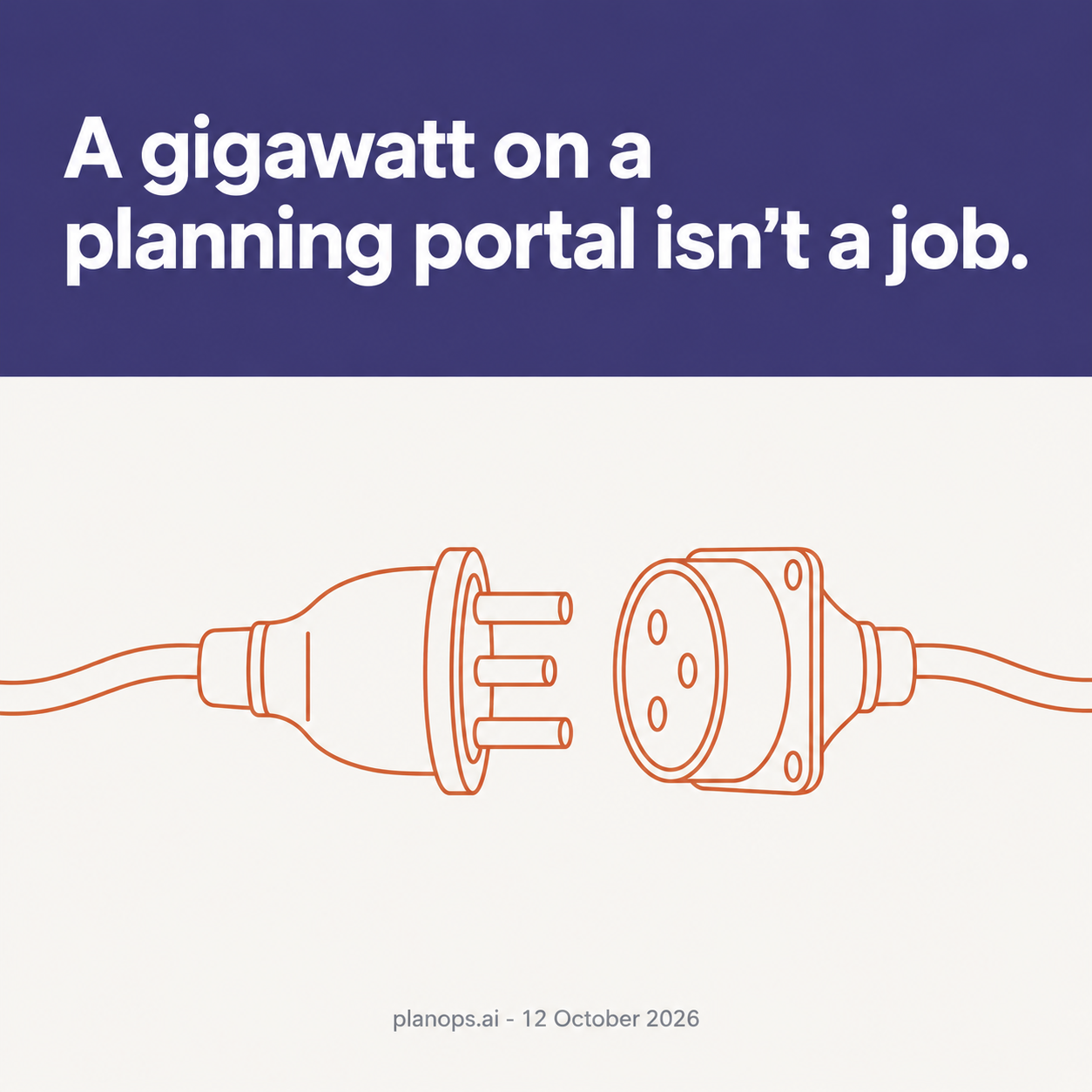
- →If you're bidding or resourcing a data-centre job, run Bain's four tests on the pipeline before you commit a team. Is the power connection real, is the customer and the financing real, is permission to build in hand, is the design stable. A gigawatt sat on a planning portal is not a job until the grid connection behind it is.
- →The thing that decides your data-centre programme is the electrician, not the chip. If you can field high-voltage and substation people you can win work others can't deliver; if you can't, no amount of AI closes that gap. Put your training and labour planning where the shortage actually bites, and say so in your bid.
- →When you next look at an AI feature in a tool you already pay for, the cost of running it has just fallen by roughly ten times. The checks that were too dear to run on every drawing or every RFI are now cheap enough to run on all of them, so ask your vendor what they're doing with that headroom, not whether they've got AI.
Ready to put AI to work on your projects?
50 free Intelligence Units. Set up your first project in under 20 minutes. No credit card needed.
Get 50 free Intelligence UnitsGet the brief by email
Daily practical AI insight for construction teams. What changed, why it matters, and what to ignore.
50 free Intelligence Units - automate your programme admin
Why PlanOps publishes this
We help construction teams turn AI into useful work, not noise. Understanding what’s changing in AI is the first step. Making it work on-site is the real difference.
Found this useful? Share it.