Weekly Roundup
The week the free options got priced
Ofgem opened a consultation on a grid commitment fee of up to £712,500 a megawatt, days after Hounslow approved a 64MW data centre near Heathrow on 6 August. Brussels moved its big AI deadline to December 2027 but left the labelling duty live from 2 August. And four product launches all landed on the same question: when the machine has drafted it, whose name goes on it.
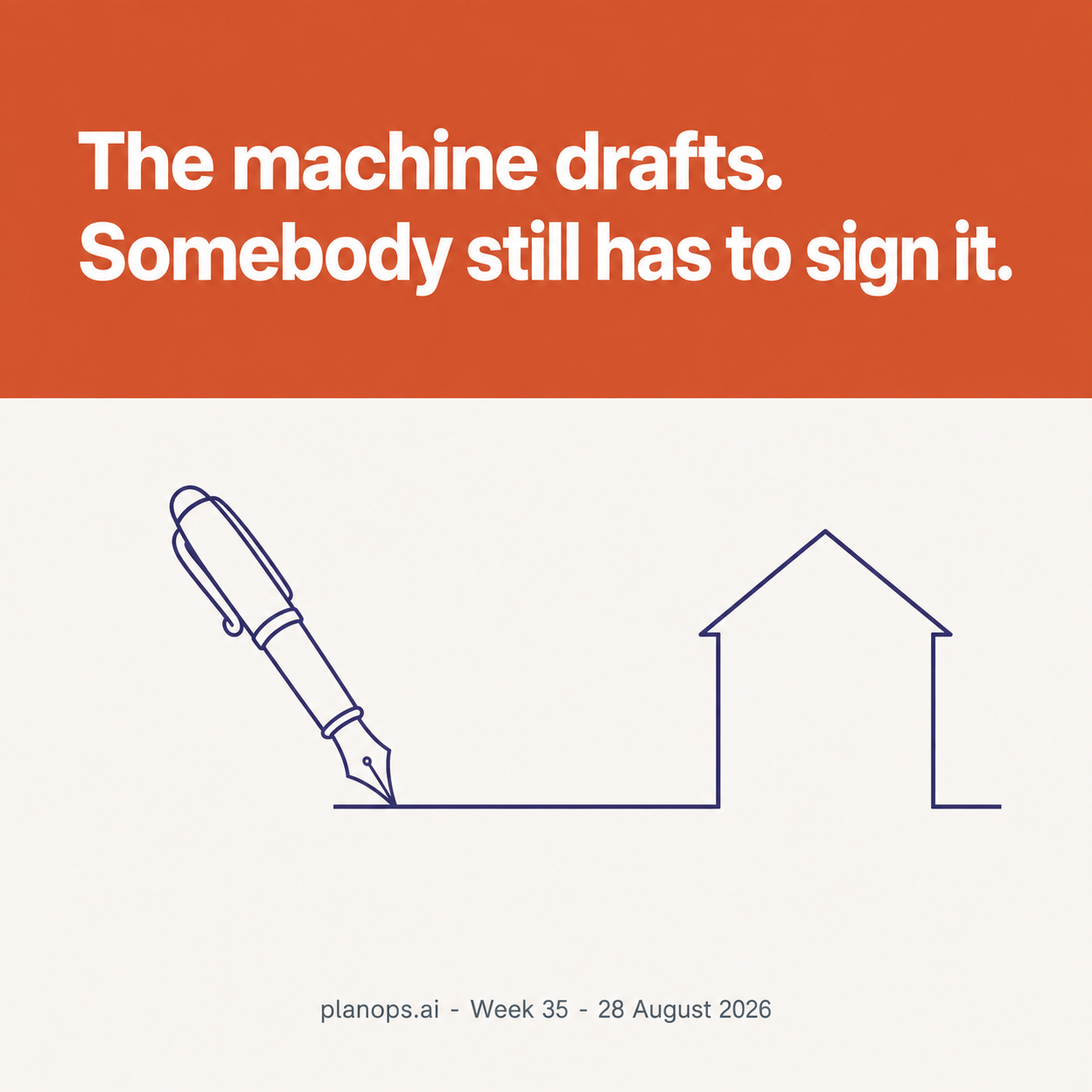
Who commits, and who signs?
So, a week where two regulators and one insurer put a price on something the industry has been getting for free, and four product launches all landed on the same question. Not whether the machine is clever. Whose name goes on what it produced.
Start with Ofgem, because that one carries a number. On 6 August 2026 Hounslow Council approved a scheme on the Haslemere Heathrow Estate: three data centre buildings up to 50,000 sqm on a 12.2-acre brownfield site off the M4, 64MW of electrical demand for 48MW of IT load at a targeted PUE of 1.35, brought forward by Brixton (Heathrow Estate) Ltd, a vehicle tied to the California investor Kennedy Wilson. It needs an 80MVA connection imported through the Laleham grid supply point, which sits outside the borough entirely. Councillors asked about water and power, and approved it anyway. Within days Ofgem opened a consultation on a Data Centre Commitment Fee, somewhere between £237,500 and £712,500 per megawatt, payable when a developer accepts a connection offer, refunded once the project connects, forfeited if it drops out early. Comments close on 16 September. For years a speculative scheme could park a connection request, hold the capacity and decide at leisure while a job that was ready to build queued behind it. Put a refundable deposit in the hundreds of thousands per megawatt against that slot and the queue starts telling the truth.
The same instinct showed up at the front of a job, in a very different form. On 25 August, Volve, an Oslo startup founded in 2024 by Herman Smith, Abyl Ikshanov and Alf Jørgen Dovland, raised $3m led by Skyfall Ventures for a platform that reads tender and contract packages and builds a structured map of scope, requirements and risk. It is live with main contractors and public clients across the Nordics and says it is building a UK presence. The angel on the cap table is Daniel Kjørberg Siraj, formerly chief executive of OBOS, which is not lab money, it is money from people who buy tendering for a living. The catch is that UK public tenders are a mess of addenda, clarifications and drawings that contradict the spec, and I would want to watch it on a live job before I trusted a risk flag. But the go or no-go call is where contractors quietly lose the most money, and it is currently carried in a bid manager's head on a Friday afternoon.
Then Brussels, which will get misreported all week. Under the Digital Omnibus, Regulation (EU) 2026/1744, published on 24 July and in force from 27 July, the compliance date for standalone high-risk AI moved from 2 August 2026 out to 2 December 2027, and for AI embedded in regulated products to August 2028. Sixteen months of room, granted because member states had neither their competent authorities nor their harmonised standards ready. What did not move is Article 50, the duty to tell people when they are dealing with AI-generated content, which applied on 2 August as planned. If you are a practice or a vendor putting AI-drawn work, models or reports into a European job, that duty is live today. It is the difference between the MOT being pushed back and the requirement to have working headlights being pushed back. One moved. One did not.
Underneath the policy, the tools. Smart Scaffolder launched a voice assistant on 19 August that lets a scaffolder complete incident reports, tie tests, harness inspections and toolbox talks by speaking to a phone, and the company reckons it halves the time on many records (its own figure, so treat it as an opening bid). The detail that made me sit up is what it does when it is unsure: it highlights the field for review rather than filling it in and hoping, and the competent person keeps control before submission. Three days later MillworkSuite went live with a platform that reads a set of PDF architectural drawings, returns a priced scope and pushes that scope into HOMAG iX, Microvellum or CabinetVision as cabinets already positioned at the width you confirmed. SMI Cabinetry says its drafting time halved, again a vendor number. Two very different trades, one design principle, and it is the right one. The machine drafts. A named person confirms. Speed is worthless if the number is wrong.
Set against that, the story where the signature question gets uncomfortable. On 6 August a Nashville startup called SiteVue AI raised a $7.5m seed co-led by Penny Jar Capital and Overture for fixed and wearable cameras that read footage in real time, and what they are trained to spot is not only defects and cycle times but near-misses, injuries, labour movement and PPE compliance. The safety case is real, and I am not going to pretend a supervisor with eyes on twelve other things catches a missing harness every time. But a camera that watches the wall is reality capture, and a camera on a lanyard that watches the person is something else, unless you have said out loud what it records, who sees it and what it will never be used for. RICS put privacy and security at the fastest-growing barrier to AI on site this year. This is where that gets tested.
Two wider moves worth holding onto. In the US, the broker Shepherd knocks up to 25% off premiums for contractors running approved site tech, on evidence that firms using OpenSpace saw up to 50% fewer loss events (insurer figures, not audited), and RockRose Risk raised $12.5m in the week to 24 August to push risk assessment, mitigation and cover into one offer. And on 20 August Google's Agent2Agent protocol formally joined the Agentic AI Foundation, the Linux Foundation body that already stewards Anthropic's Model Context Protocol, whose membership has gone from 49 a year ago to more than 250. A standards body is not exciting. But Bridgit's workforce agents and Procore's Digital Coworkers ride those rails, and the day an integration breaks because a vendor changed its mind, you will be glad it was not theirs alone to change.
So, pull the week together and one discipline runs through all of it. Somebody has to commit, and somebody has to sign. Ofgem is making developers commit money to hold a grid slot. Brussels is making producers admit what a machine wrote. Shepherd is pricing off a record somebody kept properly. And every decent tool that shipped this week stops short of the signature and hands it back. My advice is to work out, for each AI you are running or buying, where that handover sits and whose name is on it. If nobody can tell you, you have not bought a tool, you have bought an argument for later.
Top Stories This Week
Ofgem starts charging developers to hold a place in the grid queue, days after west London waved another 64MW through
On 6 August 2026 Hounslow Council approved three data centre buildings of up to 50,000 sqm on the Haslemere Heathrow Estate, a 12.2-acre brownfield site off the M4 currently carrying a row of tired industrial warehouses. The scheme needs 64MW of electrical demand to serve 48MW of IT load at a targeted PUE of 1.35, and an 80MVA connection, roughly the draw of tens of thousands of homes, imported from the National Energy System Operator through the Laleham grid supply point, which sits outside the borough. It was brought forward by Brixton (Heathrow Estate) Ltd, a vehicle tied to the California real estate investor Kennedy Wilson. Councillors put the water and energy questions and consented it anyway.
Within days Ofgem opened a consultation aimed squarely at that kind of scheme. A Data Centre Commitment Fee of between £237,500 and £712,500 per megawatt would be payable when a developer accepts a connection offer, refunded once the project actually connects, and forfeited if it leaves the queue early. Alongside the money sit data-centre-specific milestones, where a developer keeps evidencing financial capability, commercial maturity and procurement progress to hold its place. The consultation runs to 16 September 2026 and builds on the grid-connection reforms Ofgem floated at the end of July.
What this does is turn a free option into a paid commitment, and that is the whole point. For years a speculative request could sit on capacity while a job that was genuinely ready to build waited behind it. The comparison only goes so far, but it is the ticket-tout and empty-seats problem: make people put money down and the queue starts telling the truth. For a contractor or consultant chasing this work, the programme risk has moved. The planning gateway is clearing. The connection date, and now the connection cost, decides whether the job is real.
For your board pack: on every data centre pursuit, put the grid connection status and the commitment fee exposure on the risk register now, with a name against them, rather than treating them as a utilities detail for RIBA Stage 4.
Volve raises $3m to read the tender pile, and it is heading for the UK
On 25 August 2026, Volve, an Oslo startup founded in 2024 by Herman Smith, Abyl Ikshanov and Alf Jørgen Dovland, raised $3m (NOK 30m) in seed funding led by Skyfall Ventures, with Norrsken Evolve, OBOS Ventures, Antler and StartupLab alongside. What the platform does is read tender and contract documents and turn them into a structured map of scope, requirements and risk, so a bid team can work out what is actually being asked for without ploughing through several hundred pages of PDF, and can call go or no-go early. It is already used by main contractors and public-sector clients across the Nordics, and the company says it is building its presence in the UK and continental Europe.
The name on the cap table that matters most is the angel: Daniel Kjørberg Siraj, formerly chief executive of OBOS, one of the largest developers in the Nordics. That is money from people who buy tendering for a living rather than people who find it interesting. The market Volve is chasing, European construction tendering, still runs almost entirely on PDFs, so the room to help is real.
I would temper it in one place. A tool that reads a tender is only as good as the pack it is given, and UK public tenders arrive as a pile of addenda, clarifications and drawings that contradict the spec. I am not sure any model reads that cleanly on day one, and I would want to see it on a live job before I trusted the risk flags. But the go or no-go decision is where contractors lose the most money quietly, chasing bids they cannot win and mispricing the ones they do, and right now that call sits in a bid manager's head on a Friday afternoon.
The procurement filter: if you trial a tender-reading tool, keep a named estimator owning the go or no-go. The software finds the gap. A person still decides whether the job is worth chasing.
Brussels moved the big AI deadline, but not the bit that touches your drawings
This is the one that will get misreported. Under the Digital Omnibus, Regulation (EU) 2026/1744, published in the Official Journal on 24 July 2026 and in force from 27 July, the compliance date for standalone high-risk AI systems, the Annex III list, moved from 2 August 2026 out to 2 December 2027. For AI embedded in products already covered by EU product-safety law, it moved to August 2028. Sixteen months of breathing room, prompted by member states not having their competent authorities or harmonised standards ready in time.
Read the small print, because not everything moved. The Article 50 transparency obligations, the duty to tell people when they are dealing with AI-generated content, applied on 2 August 2026 exactly as scheduled. So the headline "the EU delayed the AI Act" is half true, and acting on the half is where firms will get caught. If you are a UK practice or vendor selling AI tools into the EU, or producing AI-generated drawings, models or reports for a European project, the labelling duty is live now. The heavy conformity-assessment machinery is what slipped. The honesty-about-provenance part did not.
The comparison only goes so far, but it is the difference between the MOT being pushed back and the requirement to have working headlights being pushed back. Check which is which before your compliance lead tells the board there is nothing to do until 2027.
Today's action: audit anything you produce with AI for a European client and confirm it carries a clear marker saying so. That is a half-day job now and an awkward conversation later.
The scaffolder now talks to the form, and it flags what it is not sure about
On 19 August 2026 Smart Scaffolder launched the Smart Forms AI Assistant, which lets a scaffolder complete site records by speaking to a phone. It listens, works out the context and populates the form, and the company says it cuts many routine records to around half the time. The first release covers the paperwork every scaffold contractor lives with: incident reports, harness and lanyard inspections, tie test records, toolbox talks, site audits, vehicle checks and permits, aligned to NASC guidance.
The detail that earns it a place here is what happens at the edge of the model's confidence. If a mandatory field is missing, or the assistant is not sure it has understood something, it highlights that field for review rather than filling it in and hoping, and the competent person keeps full control before anything is submitted. That is the right way round. A tie test record is a safety document somebody signs their name against, and the value of an assistant is speed on the boring bits, not a machine deciding what "adequately tied" means. The half-time figure is Smart Scaffolder's own, so treat it as vendor-reported until a contractor tells you what it does on a wet Tuesday in February.
What it changes on the ground is small and real. The bloke who has been putting off his vehicle checks and toolbox talk paperwork until the end of the shift can knock them out by talking, gloves on, still stood by the scaffold. Smart Scaffolder calls this stage one, with an AI assistant for its Smart Estimator due next year that would let an estimator describe a scaffold in plain English and get an initial model back to price. It is being shown at ScaffEx '26 on 10 and 11 September at Manchester Central.
The practical bit: next time a vendor demos an AI that fills in a form, ask one question before any others. What does it do when it is not sure? If the answer is that it flags the field for a human, keep listening.
The millwork estimate now drafts itself, and that tells you where the value sits
MillworkSuite launched its AI estimating and direct-to-CAD platform on 22 August 2026, aimed at millwork and casework shops. It reads a set of PDF architectural drawings, returns a priced scope of work, then pushes that same scope into HOMAG iX, Microvellum or CabinetVision as cabinet layouts already positioned on the wall, with the uppers, bases, countertops, vanities, toe kicks and soffits laid out. Sizes adjusted during estimating carry through to CAD, so a unit arrives at the width and depth that was confirmed rather than a round number somebody typed twice. SMI Cabinetry, an early user, says it cut drafting time in half, which is a vendor-reported figure. The company showed it at the International Woodworking Fair in Atlanta from 25 to 28 August, so it is a live product rather than a slide.
On our own test this is not challenger construction software, the broad AI-first platforms taking on the incumbents. It does one job for one trade and does it well, which makes it a point solution. Worth being precise about, because the category only means anything if we stop hanging it on everything that ships with the letters A and I.
The reason it earns a top slot is what it says about where AI pays this year. Not the robot on the showreel. The estimate that redraws itself. A joinery estimator spends real hours turning a priced take-off back into shop drawings by hand, work that was already done once in the pricing. Collapse that, keep the estimator checking rather than redrawing, and a small shop gets an afternoon back every week.
The discipline: if you buy a tool that estimates and drafts, make a named person confirm the priced scope before it becomes a bid. The drudgery goes. The check stays.
The cameras stop watching the wall and start watching the worker
Reality capture used to mean a 360 camera on a hard hat, walking the floor, comparing what got built against the model. On 6 August 2026 a Nashville startup called SiteVue AI, founded only in August 2025, raised a $7.5m seed co-led by Penny Jar Capital and Overture for something a step past that. Its fixed and wearable cameras run custom-trained models over the footage in real time, and what they are trained to spot is not only defects and cycle times but near-misses, injuries, labour movement and PPE compliance. It installs in days with no infrastructure change, on subscription pricing. The company says customers typically see a 3% margin uplift within three months and, in some cases, up to ten times their spend back. Those are vendor figures, and I would want to see the ten-times survive a wet January on a groundworks package.
The safety case is real, and I will not pretend otherwise. A camera that flags a bloke stepping into a swinging load, or a missing harness at height, is doing something a supervisor with eyes on twelve other things cannot. But there is a line the sector has not drawn yet, and this is the story where the signature question gets uncomfortable. The RICS survey published on 18 August found the barrier to AI on site that grew fastest in a year was not cost but trust, with privacy and security concerns jumping from 22% to 30%. A camera that watches the wall is reality capture. A camera on a lanyard that watches the person is surveillance, unless you have said out loud what it records, who sees it and what it will never be used for.
Worth doing: before any monitoring camera goes live, put a one-page notice into the induction covering what it captures and who can access it, and keep the footage out of the disciplinary process unless you have told people that is where it goes. The person it is pointed at is the one whose buy-in you actually need.
The best return on your site tech might be sitting with your insurer
We argue about AI in terms of hours saved, an afternoon off the take-off, a Friday back on the bid. Fair enough. There is a second return that is easier to bank, and it turns up at renewal. In the US, the broker Shepherd runs a programme called Shepherd Savings that knocks up to 25% off insurance premiums for contractors using approved site tech: Procore, Autodesk and Raken on project management, OpenSpace and DroneDeploy on reality capture, telematics and sensors on top. The logic is evidence-led. Shepherd found firms running OpenSpace had up to 50% fewer loss events and materially lower loss rates after adoption. Those are the insurer's figures, so treat them as a claim rather than a law of nature.
The idea is attracting money. In the week to 24 August 2026, a startup called RockRose Risk raised $12.5m to push it further, wrapping risk assessment, the mitigation work and the insurance itself into one vertically integrated offer. It rhymes with what the challenger insurers did to motor cover: price the risk off real data instead of a rating table, and reward the people who lower it.
None of this is packaged the same way in the UK yet, so do not ring your broker expecting a menu. But the mechanism travels, and it reframes the adoption argument. If a tool cuts your claims, the data it throws off is worth money to an underwriter, and that is a harder number to argue with than "it saved us time". The site manager keeping a clean visual record is not doing admin. They are producing evidence, and evidence prices risk.
A practical step: at your next renewal, ask your broker whether any of the tech you already run counts towards the premium. If you get a blank look, you have found a conversation worth starting.
Automate your programme admin. Get your evenings back.
Also Worth Noting
Birdsview raises €3.7m to scan the concrete without breaking it
Birdsview, a Norwegian company, raised €3.7m this month for non-destructive concrete scanning. It runs ground-penetrating radar and lidar over a structure and turns the sensor data into a 3D model showing rebar position, slab thickness, and the cracks, voids and corrosion hiding inside, without a drill going near it. The old way is to core a slab, test that plug in a lab and extrapolate across everything you did not drill, which is one point pretending to speak for a whole floor.
The caveat is the usual one. Radar and lidar hand you data, not judgement, and somebody who understands reinforced concrete still has to read the model. But it puts far more of the slab in front of that person, with no core hole to backfill and no lane closure while you patch it. For anyone dealing with ageing concrete, bridges, car parks, 1970s frames, that changes how a condition survey gets done.
Worth doing: if you have an existing-structure survey scoped for coring this autumn, price a scan alongside it and compare the making-good and closure costs, not just the survey fee.
Source: Last Week in ConTech, 24 August 2026 (ConTech Roundup) →
The rails under the construction agents settled under one roof
On 20 August 2026 Google's Agent2Agent protocol, known as A2A, formally joined the Agentic AI Foundation, the Linux Foundation body that already stewards Anthropic's Model Context Protocol. Axios flagged the move on 17 August and it was confirmed on the 20th. MCP is the layer that lets an agent reach into your project database, your drawings and your RFI log. A2A does the other half, letting one agent hand work to another. Two protocols, two jobs, one neutral home, with the foundation's membership up from 49 a year ago to more than 250. In the same period MCP passed 400 million SDK downloads a month on Anthropic's own figures, Claude Security opened in public beta for enterprise customers, and Anthropic retired its experimental prompt-tools APIs on 17 August.
Why should a contractor care about a governance reshuffle? Because the construction agents this brief has tracked plug straight into those rails. Bridgit's workforce-planning agents talk to ChatGPT, Claude, Copilot and Gemini through an MCP server, and Procore's Digital Coworkers sit on the same kind of connection. When the standard your tools depend on belongs to one company, that company's roadmap is your risk. I am not going to pretend a standards body is exciting. But the day an integration breaks because a vendor quietly changed its mind, you will be glad it was not theirs alone to change.
The procurement filter: when a vendor says their agent connects to your systems, ask which protocol, then make "show me the access scope and the audit log" a scored question in the tender.
Sir Robert McAlpine makes the case for data as the skills fix
On 14 August 2026, Nadeem Mirza, resource and workforce planning director at Sir Robert McAlpine, argued in Construction Management that the skills shortage is a structural crisis and that AI-gathered data on people's strengths, competencies and working styles is how you place the right person on the right project and stop them drifting to a competitor. His line was that nobody should leave the planning to the machines, but should use them to generate richer data that a human then interprets.
That is the same instinct as the tool launches, applied to people rather than paperwork. It also lands on the one problem AI cannot conjure its way out of. No model on the internet produces an electrician.
The takeaway: before you buy a workforce tool, write down the three decisions you want it to inform. If you cannot name them, you are buying a dashboard.
Continuous compliance gets a hearing while the gateway queue clears
We covered the Building Safety Regulator's Gateway 2 numbers last week and they have not moved: median new-build approval down from 43 weeks a year ago to 22, approvals at 82% across all categories on the data to 1 August 2026. What is new this week is the argument building around them in the trade press, that the answer to a document-heavy regime is continuous compliance rather than a scramble before each submission.
That is worth taking seriously, because the gateway is a document exercise before it is anything else, and the approvals ride on the quality of the pack. Keeping that pack current, flagging the drawing that changed since the last submission, chasing the missing fire-strategy sign-off before it invalidates an application, is unglamorous and it is exactly what AI is good at. A bit like a document controller who never sleeps.
For your board pack: pick one gateway or handover pack in preparation this quarter and answer two questions. Who is keeping it current, and could an assistant do the chasing so the humans do the judging.
The pilot-to-production gap is still the number that matters
RICS published its AI in Commercial Property and Construction Report 2026 on 18 August, from more than 3,100 responses. The headline everybody quoted was that two thirds of construction professionals now use AI in some form. The number that should bother you is the next one: regular use, where a tool has earned a place in someone's week, is 19% in construction against 29% in commercial property, and 39% of both sectors are still running early pilots.
So the sector is not short of proofs of concept. It is short of workflows that made it into daily use and stayed there. A records tool that fills in a tie test, or an estimating tool that drafts, is worth more than another pilot precisely because somebody uses it on Monday morning without being asked.
A practical step: list every AI tool your teams trialled this year and mark which ones became routine. The blank rows are the actual programme of work.
Source: RICS AI in Commercial Property and Construction Report 2026 →
What matters most
- →"On any data centre pursuit, move the grid connection and the commitment fee exposure onto the programme risk register this week, with a name against them, rather than picking them up at Stage 4."
- →"Check whether anything you produce with AI for a European client carries a marker saying so. The labelling duty is live now, whatever the headlines said about a delay to 2027."
- →"Ask your broker at the next renewal whether the site tech you already run counts towards your premium. The record your tools throw off may be worth more than the hours they save."