Construction AI Brief
Construction AI: the product data hub passes its first test, and the accounting agents raise another $30m
The Manufacturers' Information Hub has completed its UKRI-backed proof of concept, a manufacturer-owned way to connect specifiers and contractors straight to source product data instead of chasing the latest PDF. And Adaptive has raised a $30m Series B to put AI agents through the construction ledger, one of the clearest signs yet that the back office, not the site robot, is where AI is quietly earning its keep.
AI-assistedPrepared with AI assistance and human editorial review.
Today’s context: This brief covers the latest movements in AI tooling, adoption, and signals for construction teams. Read on for what matters and what to focus on.
Industry Readiness: Featured
The Manufacturers' Information Hub clears its proof of concept
Here's a quiet one that matters more than its headline suggests. On 21 September the trade press reported that the Manufacturers' Information Hub has finished its UKRI-backed proof of concept, the first real milestone for a manufacturer-owned, not-for-profit platform meant to fix how construction product data moves around.
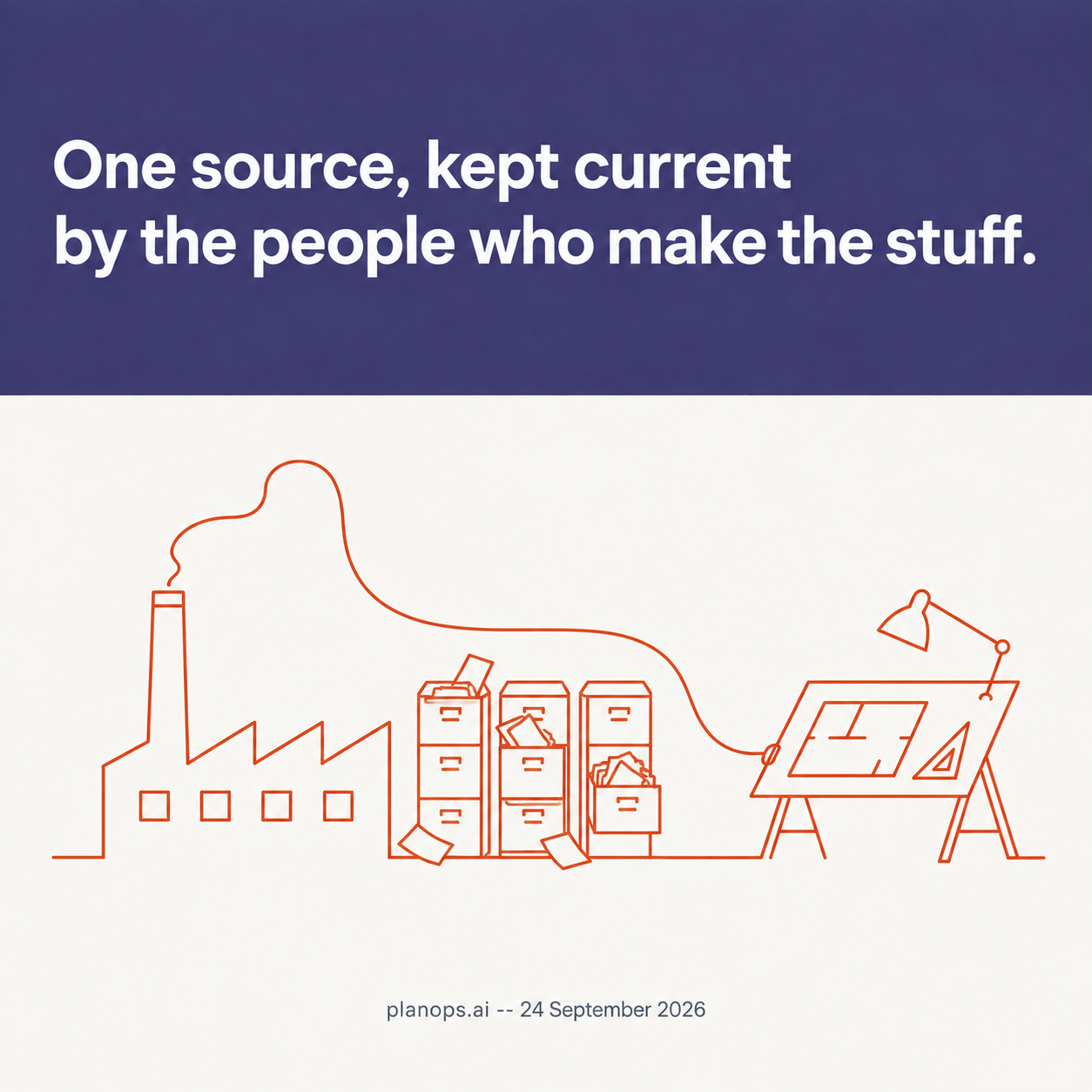
The problem it's aimed at is one every specifier and QS knows in their bones. A product's specification, its certificates, its technical details, all of it currently travels as a mixture of PDFs, BIM objects, spreadsheets and separate portals. Someone downloads it, drops it into a spec, and from that moment it starts going stale. When the manufacturer changes something, every copy out in the wild is quietly wrong. What the Hub proposes is a common data dictionary and a standard API, so instead of copying the data you connect to it, held and maintained at source by the people who make the product. It's supported through UKRI's Industrialising and Digitalising Construction challenge, with a working prototype targeted for spring 2027 and first functionality set for 2028.
The reason to take it seriously is who's behind it. The named supporters include Knauf, Sika, Etex, Siderise, Heidelberg Materials, Wienerberger, Kingspan, Saint-Gobain and Tata Steel UK, with GS1 on the standards side and contractors Kier, Bovis and Sir Robert McAlpine in the room. That's a proper slice of the products supply chain, not two enthusiasts and a slide deck. And I'd point at Siderise and Kingspan specifically. After everything fire barriers and cladding have cost this country to sort out, a trusted, current record of exactly what a product is, tied to traceability and the coming digital product passports, is the golden thread getting some plumbing under it rather than another policy paragraph.
So, the caveat, plainly: this is a proof of concept, not a live system, and the useful version is two years out. The real test isn't the tech, it's whether manufacturers keep their records current and whether the design and estimating tools people already use can pull the data without adding another manual step. A shared standard is only worth anything if it turns up inside the software the person doing the paperwork already has open. Get that right and the specifier stops ringing round for the latest datasheet. That's what it's about.
Tools & Platforms
Adaptive raises $30m to let agents run the construction ledger
While everyone films the drones, the money this week went into the back office. On 17 September Adaptive, an agentic accounting platform built for construction, closed a $30m Series B led by Tidemark, with existing backers Emergence Capital, Andreessen Horowitz, Pathlight, Definition and 3KVC alongside. That takes the company to $57m raised, and the cash is going into what it calls Project Accounting Agents, working across job costing, accounts payable, billing, work in progress, payments and compliance. Adaptive reports more than 750 construction operators using it, from general contractors to specialty trades and developers, though that user figure is the company's own.
The framing from the investor is worth quoting, and worth reading with a raised eyebrow. Tidemark's Dave Yuan called Adaptive "a System of Action" that "doesn't just help construction finance teams do the work, it increasingly does the work itself." That's vendor language and it's doing some work of its own. But strip the polish off and there's a real point underneath. The construction back office runs on repetitive, rules-based tasks that eat a bookkeeper's week: matching invoices to cost codes, chasing retentions, keeping WIP honest. That's exactly the shape of work an agent can actually take on, far more than the site-inspection stuff that gets the glossy launch video.
I'm not sure a US firm's product drops neatly into a UK contractor's month-end, because our retention rules, CIS and VAT reverse charge aren't a menu setting. The comparison only goes so far. But the direction is the one to watch: the clearest early wins for AI agents in construction are landing in finance and admin, not on the scaffold. So if you're weighing where to spend, look at the person reconciling the ledger before you look at another camera on a pole. That's the seat where the hours actually go.
Adoption & Evidence
What to do before the NEC opens its doors
Both of this week's stories point the same way. The Hub is about trusting information at its source instead of copying it, and Adaptive is about handing the repetitive paperwork to something that'll do it the same way every time. Underneath the two, it's the same discipline: your data and your admin are the foundations, and the clever tools are only as good as those foundations are clean.
Which makes the timing handy, because UK Construction Week runs at the NEC Birmingham from 29 September to 1 October, and this year there's a new Contech and AI Hub, one of six stages across a programme billed at more than 150 hours of CPD-accredited seminars. It's a chance to see the product-data and agent-workflow claims up close, with live demos rather than press releases, and to ask the awkward questions in person. What data does it touch. Who keeps it current. What happens when you want to leave.
Today's action: if you're heading to the NEC, pick one vendor on the Contech and AI Hub and ask them to show you their product working on your kind of job, with your data shape, not the demo dataset. If they can't, that's your answer, and you've saved yourself a procurement cycle finding it out.
What matters most
- →If you specify or procure products, treat the Hub as a two-year signal, not a tool you can use next month: the win is source data you connect to, but nothing lands on site until spring 2027 at the earliest.
- →The Siderise and Kingspan names on the backer list are the tell. Post-Grenfell, a trusted, current record of what a cladding or fire-barrier product actually is matters more than any dashboard.
- →Before you buy the next AI feature for the site, look at your finance office. Job costing, AP and WIP are where the admin actually piles up, and where an agent has the clearest run at it.
Ready to put AI to work on your projects?
50 free Intelligence Units. Set up your first project in under 20 minutes. No credit card needed.
Get 50 free Intelligence UnitsGet the brief by email
Daily practical AI insight for construction teams. What changed, why it matters, and what to ignore.
50 free Intelligence Units - automate your programme admin
Why PlanOps publishes this
We help construction teams turn AI into useful work, not noise. Understanding what’s changing in AI is the first step. Making it work on-site is the real difference.
Related issues
data-centrestools
Construction AI: the grid, not the planners, is what's holding up Britain's biggest AI data centre
Nscale's £2bn Loughton scheme has the money, the GPUs and the planning nod, and it's still slipping into 2027 because of a power connection. Grok 4.7 lands the same week in the coding tools your team may already be using, and Gilbane pushes AI agents across 200-plus jobsites.
- • Nscale's Loughton, Essex site has planning backing and £2bn behind it, yet a 90MW grid connection has pushed go-live from Q4 2026 into 2027
- • Grok 4.7 shipped on 21 September at the same $2/$6 per-million-token rate as 4.6, and is already selectable inside GitHub Copilot and Cursor
Found this useful? Share it.