Construction AI Brief
Construction AI: the data-centre boom hits a wall of power and water, and Google quietly ships Deep Think
A quiet news week, so a fundamentals one. New Civil Engineer's 24 June deep dive lays out the bottleneck the AI building boom keeps running into, and it isn't planning, it's grid and water. The pipeline of demand waiting for a connection has tripled to 125GW, more than the country's entire peak demand. And on 22 June Google shipped Gemini 2.5 Pro with Deep Think, the long-document reasoning the awaited 3.5 Pro was supposed to bring, just under a different badge.
AI-assistedPrepared with AI assistance and human editorial review.
Today’s context: This brief covers the latest movements in AI tooling, adoption, and signals for construction teams. Read on for what matters and what to focus on.
Industry Readiness — Featured
The data-centre boom's real bottleneck isn't planning, it's power and water
We've spent a fair bit of this month on the planning fight over data centres, the design competition, the green-belt call-ins, the noise objections. New Civil Engineer's in-depth report on 24 June 2026 makes the case that we've been looking at the wrong constraint. The thing that actually decides whether a UK data centre gets built isn't the planning committee. It's whether you can plug it in and keep it cool.
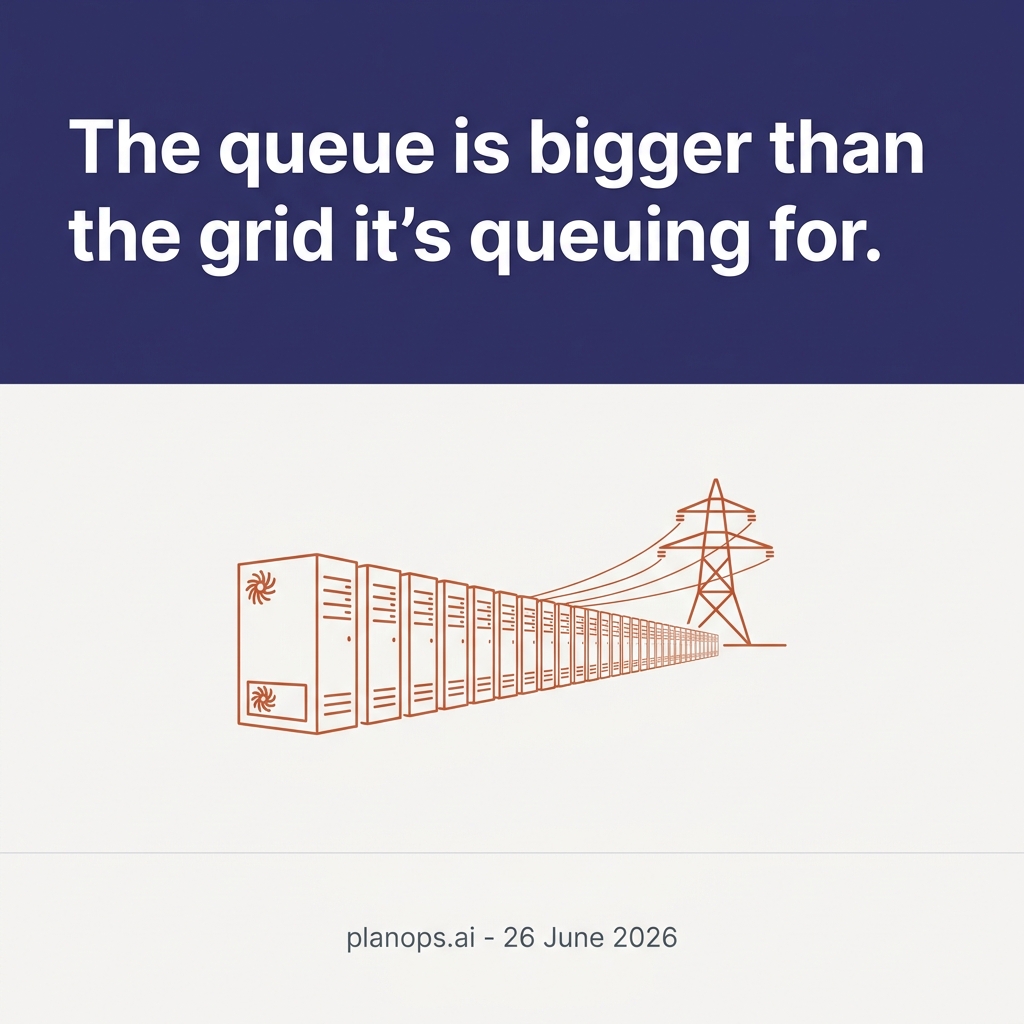
Start with power, because that's where the queue is. The pipeline of demand waiting for a grid connection tripled in roughly seven months, from 41GW in November 2024 to about 125GW by June 2025, with somewhere near 50GW of that tied to data-centre schemes. Put that next to the fact that the whole country's peak electricity demand is around 45GW and you see the problem, the queue is bigger than the grid it's queuing for. On the ground that translates into a connection lead time of about seven years for a new 50MW site in London, per the figures NCE and others cite, and over a year even for an approved high-capacity connection. A consented site behind that wait is a slide in a deck, not a project. Ofgem has clocked it too, and its demand-connections reform, with phase one aimed specifically at the data-centre sector, is built to filter out the speculative bids clogging the line, refundable deposits tied to milestones, commitment fees, and likely proof of planning before you even join the queue.
Then there's water, which gets far less airtime and shouldn't. A single megawatt of data centre can use up to 25.5 million litres a year for cooling, roughly the daily consumption of 300,000 people, and the Environment Agency is already warning of possible drought in 2026. The comparison only goes so far, because the better operators are moving to closed-loop and air cooling that barely touches the potable supply, and treated effluent can do a lot of the rest. But if you're a contractor or consultant pricing a data-centre job, the cooling strategy is now a commercial question as much as an engineering one, and "we'll sort it later" is not an answer a water-stressed region will accept.
The procurement filter: Next time a data-centre opportunity crosses your desk, ask two questions before you ask about planning. What's the grid connection date, in writing, and what's the cooling strategy and its water draw. If the answers are vague, you're being sold the easy half of the problem.
Wider AI
Google ships Deep Think, the reasoning the awaited Gemini never quite delivered
A short, honest follow-up to a thread we've been pulling on. For weeks the trade chatter, and this brief, flagged Google's Gemini 3.5 Pro as the model to watch, a June release built for the long-document reasoning a golden-thread pack demands. As of last week, 3.5 Pro still hadn't landed in general availability. What did land, on 22 June 2026, was Gemini 2.5 Pro with Deep Think, made available immediately on the Gemini API, AI Studio and Vertex AI, with a 2-million-token context window and a step-up reasoning mode that Google's own benchmarks put at the front of the pack on science, maths and code.
So the capability arrived, just wearing a different badge than the one everyone was waiting for. That's worth saying plainly rather than pretending the prediction was bang on. What Deep Think actually does, for our purposes, is hold a very large document set in its head and reason across it in one pass, which is exactly the shape of the problem when you're checking an O&M manual against a safety case, or interrogating a fat specification for the clause that contradicts the drawings. The 2-million-token window is the headline, but the reasoning mode is the part that matters, because long context without good reasoning just gives you a confident summary of the wrong thing.
I'd voice the same caution I always do, and mean it. A model that's brilliant on a benchmark can still miss the one buried inconsistency that costs you on site, and Deep Think reportedly runs at around four times the standard token cost, so it's not the thing to point at every email. Use it where the document load is genuinely heavy and the stakes justify the spend, test it first on a job you've already closed where you know the right answer, and keep the competent person on the sign-off. That's what it comes down to, evidence before trust.
A practical step: Pick one document-heavy task your team dreads, an O&M review, a spec cross-check, and run it through Deep Think against an answer you already trust. If it finds what your reviewer found, you've got a time-saver. If it invents a problem, you've learned that cheaply, before it touched a live job.
Adoption & Evidence
Two stories, one discipline: check the constraint before you chase the prize
Stand back from a thin week and the two items rhyme more than they look. Both are about the gap between a capability that exists and a capability you can actually use. The data-centre pipeline is real and enormous, but it's gated by power and water, not by your ability to draw the shed. Deep Think reasoning is real and impressive, but it's gated by whether you've checked its output against something you trust. In both cases the headline is the easy part and the constraint is the job.
For a UK firm the takeaway is the same one I keep landing on. Do the boring diligence first. On a data-centre bid, that means the grid connection date and the cooling strategy before the planning narrative. On an AI tool, it means a shadow test on finished work before it touches a live submission. None of this is glamorous, and it's exactly the bit that separates the firms that make money out of this cycle from the ones that get caught holding a consented site they can't power and a model output they can't defend.
The takeaway: Chase the data-centre work, but qualify it on power and water, not planning. Use the new reasoning models, but qualify them on a job you already know. The constraint, not the headline, is where the risk lives.
What matters most
- →"If your firm is chasing the data-centre pipeline, read the grid queue and the water position before you read the planning policy. A connectable, water-sensible site beats a consented one stuck behind a seven-year wait."
- →"Ofgem is about to make the queue harder to sit in speculatively, with deposits, milestone fees and proof of planning likely required. That's good for serious schemes and bad for land-banked options. Know which one your project is."
- →"Deep Think reasoning on a 2-million-token window is genuinely useful for golden-thread and O&M packs, but test it on a job you already know cold before you trust it on one you don't. The capability shipped; the verification is still your job."
Ready to put AI to work on your projects?
50 free Intelligence Units. Set up your first project in under 20 minutes. No credit card needed.
Get 50 free Intelligence UnitsGet the brief by email
Daily practical AI insight for construction teams. What changed, why it matters, and what to ignore.
50 free Intelligence Units - automate your programme admin
Why PlanOps publishes this
We help construction teams turn AI into useful work, not noise. Understanding what’s changing in AI is the first step. Making it work on-site is the real difference.
Related issues
industry-readinessgovernment-policy
Construction AI: the regulator got quicker, and the housing starts followed
England's new-build starts jumped 20 per cent year on year in the second quarter, and the Building Safety Regulator's faster higher-risk approvals are a real part of why, though the headline number is flattered by how those starts are now counted. And two big AI days land at once today: UK Construction Week opens in Birmingham with a full AI stage, and OpenAI's DevDay sets the direction for the tools your team already opens.
- • England new-build starts hit 35,910 in the second quarter of 2026, up 20 per cent on a year earlier and 6 per cent on the previous quarter, per the government's April to June housing supply figures reported on 25 September.
- • The Building Safety Regulator now reports higher-risk building starts separately, 5,758 in the quarter against a previous peak of 1,206, and those make up roughly 16 per cent of the total, so part of the 20 per cent jump is starts that simply weren't counted this way before.
Found this useful? Share it.