Construction AI Brief
Construction AI: a design contest for data centres, and the G7 softens the AI rulebook
On 11 June the government and RIBA launched the UK's first data-centre design competition — a cultural answer to the planning backlash pushing 147MW sheds past objecting councils. The G7 wound down in Évian on 17 June with its AI-governance language expected to soften, and Anthropic gave its coding agents the power to spawn their own sub-agents — then shipped a safe mode to switch them off.
AI-assistedPrepared with AI assistance and human editorial review.
Today’s context: This brief covers the latest movements in AI tooling, adoption, and signals for construction teams. Read on for what matters and what to focus on.
Government & Policy — Featured
The government turns data centres into a design competition — and it's really about the planning backlash
On 11 June, at London Tech Week's AI Summit, the Minister for AI and Online Safety, Kanishka Narayan MP, announced the RIBA x DSIT Data Centre Design Challenge — described as the first government-backed design competition of its kind, run jointly by the Department for Science, Innovation and Technology and the Royal Institute of British Architects. It's open to architects, designers and engineers, with communities pulled into the framing too. The brief asks entrants to raise the bar on design quality, public engagement and environmental outcomes, and to reimagine data centres as "places of genuine civic value" — buildings people can be proud of, in the government's words, rather than ones they tolerate.
Read it in context and the politics are obvious. We've spent the last fortnight in this brief watching data centres punch through local opposition: the 147MW Slough scheme approved on a part-greenfield appeal on 10 June, the Ravenscraig steelworks reuse the week before. The planning system is clearing the AI build-out, council objections and all. A national design competition is, in part, the cultural answer to that political problem — if you can't stop the sheds, at least make them worth looking at. So be clear-eyed about what this is. It's a design-ideas competition, not a planning requirement; no developer is obliged to build the winning concepts, and the full eligibility rules, timeline and judging criteria were still to be confirmed when it was announced. Treat it as influence, not regulation.
That said, influence at the design-brief stage is exactly where a typology gets set. Data centres are about to become one of the larger lines in the UK construction pipeline, and most are being drawn to a logistics-shed standard because nobody has asked for better. If you run a practice with data-centre exposure — or you want some — this is a low-cost way to plant a flag on what good looks like, and to be in the room before local authorities start writing "civic value" into their conditions of consent. Once a government competition has legitimised the phrase, some of them will.
The practical bit: If your practice touches the data-centre pipeline, watch for the full competition brief from RIBA and put an entry in — the design standard set here will become the language planners reach for to push back on the next bad shed.
The G7 winds down in Évian — and the AI rulebook gets softer, not firmer
The 52nd G7 summit, hosted by France in Évian, ran from 15 to 17 June. AI was on the agenda, but the trajectory reported across the week was that the governance language would be diluted compared with the harder commitments of two years ago — the focus pivoting to AI's economic upside, with the United States resisting any multilateral agreement it reads as a brake on its industrial lead. TechPolicy.Press described the run-up as a "widening rift over AI sovereignty." All three frontier-lab chiefs — Sam Altman, Dario Amodei and Demis Hassabis — were reported in attendance, said to be the first time the rivals have appeared before G7 leaders together. One caveat worth stating plainly: at the time of writing, on 17 June, the final communiqué language was still emerging, so take the detail as provisional and watch for the published text.
Why should a UK site director care what happens in a French spa town? Because the missing global rulebook is the story. If the G7 won't harmonise, the rules that bind a UK construction firm stay exactly where they sit today: the UK's own emerging regime, and — the date that actually matters — the EU AI Act's high-risk obligations from 2 August, which we covered yesterday and which reach any AI output of yours that ends up used in the EU. A softer G7 line doesn't lighten that load. It removes the excuse to wait for someone to standardise it for you. If you work across UK, EU and US markets, you're now planning for divergence rather than convergence — different obligations in each, and no treaty coming to tidy them into one.
For your board pack: Don't let "the G7 went soft on AI" turn into a reason to slow your own governance work — the EU AI Act deadline is fixed at 2 August, and fragmentation means more compliance surfaces to manage, not fewer.
Tools & Platforms
Anthropic gives its agents the power to spawn their own agents — and an off switch in the same breath
On 16 June, Anthropic shipped an update to Claude Code, its agentic coding tool, that's more interesting for what it signals than for the developer features in the changelog. Two changes stand out. Sub-agents can now spawn their own sub-agents — hierarchical, self-directing chains of AI doing work without a human at every step. And there's a new "safe mode" that isolates a broken or misbehaving configuration so you can troubleshoot it, sitting alongside stronger permission rules and tighter admin controls. More autonomy and more containment, announced together.
This is the layer underneath the stories we keep running. When Procore, Autodesk Forma and Bluebeam wire agents into your project data through MCP — the orchestration standard the whole AEC stack has now adopted — this is the kind of machinery doing the orchestrating. An agent that can spin up its own sub-agents to, say, chase a clash across a model, draft the RFI and update the daily log is genuinely useful and genuinely harder to supervise. The fact that Anthropic shipped the brakes in the same release as the engine tells you the people building this know the supervision problem is real. Set it against the policy news above and the contrast is sharp: the labs are bolting on their own guardrails faster than governments are agreeing on any.
A fair caveat — Claude Code is a developer tool, not a construction product, and most readers will never open it. But it's the substrate your software vendors build on, and capabilities that land here tend to surface in your tools a few months later. You don't need to install it. The point is to carry its question into your next vendor conversation: when an agent acts across our project data, can we see every step it took, can we set exactly what it's allowed to touch, and is there a safe mode that stops it cold? A vendor who can't answer all three isn't ready to put an agent on a live job.
The procurement filter: Ask any agent vendor for three things — a full audit trail, granular permissions and a hard stop. Anthropic just built all three into its own tool; accept nothing less in yours.
Adoption & Evidence
Three stories, one instinct: set the standard yourself
A pattern runs through all three. The government is asking architects to set a design standard for data centres because the market won't on its own. The G7 declined to set a governance standard, so the standard you're held to is whichever regime reaches you first. And Anthropic wrote its own safety standard into a product before any regulator asked it to. The throughline for a UK construction business is the one we keep landing on: the standard that protects you is the one you set and write down — and waiting for someone else to set it for you is the slowest route there is.
So the standing discipline holds. If you're near the data-centre pipeline, get into the RIBA conversation and shape the brief. If you use AI on anything safety-critical, or anything that touches the EU, the 2 August deadline is real and the G7 hasn't moved it. And if a vendor wants to put an agent near your golden thread, make them show you the audit trail, the permissions and the off switch before it goes anywhere near a live project. None of this needs a budget line. It needs someone to decide it's their job this quarter. The profession has form here — RICS made responsible AI use a binding professional standard for its members back in March, ahead of any law forcing it. That's the instinct to copy.
Today's action: Pick the one of these three closest to your work this week — the design challenge, the August deadline or the agent off switch — and put a name against it before Friday.
Source: RICS launches "landmark" global standard on responsible AI use — PBC Today →
What matters most
- →If you're an architect or engineer near the data-centre pipeline, the RIBA challenge is a live route to shape what these buildings become — and a planning argument worth having
- →Don't read the G7's softer line as relief — the rules that bind you are the UK's own and the EU AI Act from 2 August, and they aren't getting looser
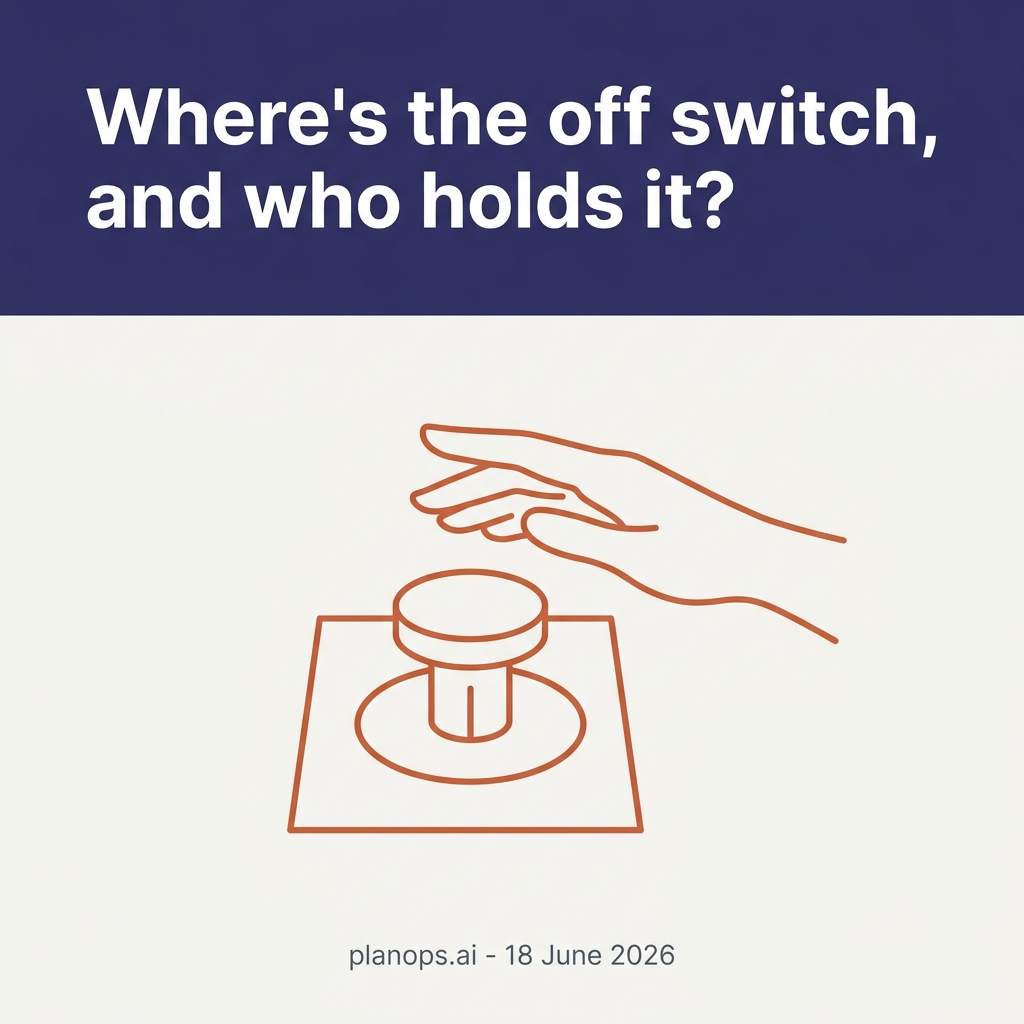
- →Before you let an AI agent act across your project data, ask your vendor the question Anthropic just answered for itself — where's the off switch, and who holds it
Ready to put AI to work on your projects?
50 free Intelligence Units. Set up your first project in under 20 minutes. No credit card needed.
Get 50 free Intelligence UnitsGet the brief by email
Daily practical AI insight for construction teams. What changed, why it matters, and what to ignore.
50 free Intelligence Units - automate your programme admin
Why PlanOps publishes this
We help construction teams turn AI into useful work, not noise. Understanding what’s changing in AI is the first step. Making it work on-site is the real difference.
Related issues
industry-readinessgovernment-policy
Construction AI: the regulator got quicker, and the housing starts followed
England's new-build starts jumped 20 per cent year on year in the second quarter, and the Building Safety Regulator's faster higher-risk approvals are a real part of why, though the headline number is flattered by how those starts are now counted. And two big AI days land at once today: UK Construction Week opens in Birmingham with a full AI stage, and OpenAI's DevDay sets the direction for the tools your team already opens.
- • England new-build starts hit 35,910 in the second quarter of 2026, up 20 per cent on a year earlier and 6 per cent on the previous quarter, per the government's April to June housing supply figures reported on 25 September.
- • The Building Safety Regulator now reports higher-risk building starts separately, 5,758 in the quarter against a previous peak of 1,206, and those make up roughly 16 per cent of the total, so part of the 20 per cent jump is starts that simply weren't counted this way before.
Found this useful? Share it.