Construction AI Brief
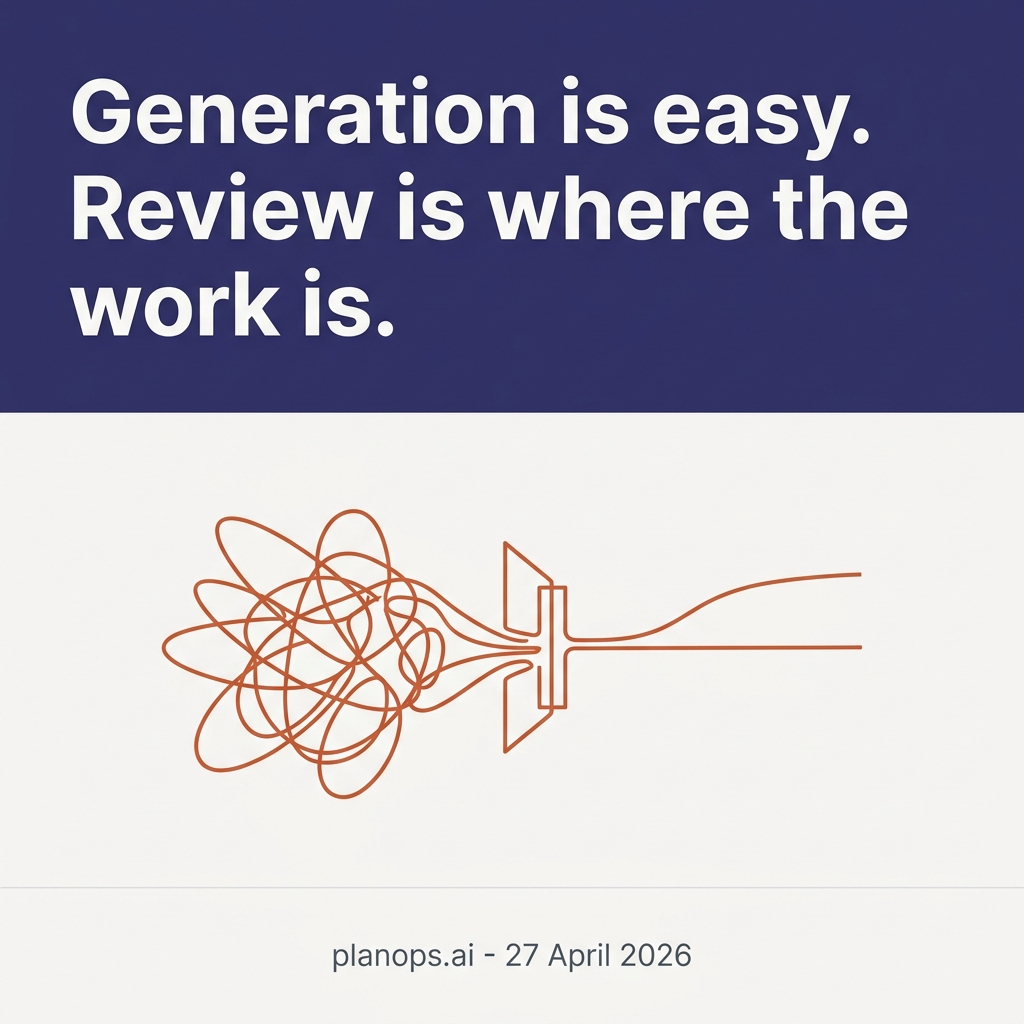
AI is moving from generation to review
Shopify, OpenAI and Qwen show the real bottleneck is now review, orchestration and deployment, not raw generation.
AI-assistedPrepared with AI assistance and human editorial review.
Today’s context: This brief covers the latest movements in AI tooling, adoption, and signals for construction teams. Read on for what matters and what to focus on.
UK Infrastructure & Investment
Shopify's AI lesson: review is now the bottleneck
Shopify CTO Mikhail Parakhin said the company now spends more effort on critique loops, PR review, testing and deployment stability than on generation itself. That is the right way to think about it.
The point is simple. AI can write more code than before. The problem is that more code also means more bugs, more failed tests and more pressure on delivery pipelines. Parakhin's team is pushing expensive models into review, while keeping generation relatively cheap.
That maps neatly to construction delivery. If you automate too early and skip the control points, you just create a faster mess.
Why it matters
If you want AI to help on projects, the win is in review, checks and workflow control, not just in drafting faster.
Tools & Platforms
OpenAI turns Codex into a broader work agent
OpenAI's GPT-5.5 launch bundled a much bigger Codex update. Browser control, Docs, Sheets, Slides and auto-review all moved into the same workspace direction.
That matters because it shows where these tools are heading. They are no longer just code assistants. They are becoming work agents that can move across documents, spreadsheets and web apps.
For construction teams, that means the useful unit is not the model. It's the stack around it. The review loop. The permissions. The handoff into the tools your team already uses.
Why it matters
The best AI systems in practice will sit inside your process, not outside it.
Wider AI Developments
Qwen 3.6 makes open models harder to ignore
Qwen 3.6 27B landed as a serious open coding model, with strong benchmark claims and broad local support across vLLM, Ollama and llama.cpp. Community reaction was immediate because the model looks good enough to compete on real tasks, not just on slides.
But, the bigger story is what that does to cost and deployment choices. If an open model can get close enough for a lot of office and back-office work, the default assumption shifts. You don't have to send everything to a frontier API.
That has obvious implications for construction firms handling sensitive project data.
Why it matters
Cheaper open models make it easier to keep more work in-house, especially where data privacy matters.
Wider AI Developments
Google and OpenAI keep pushing the agent stack
Google used Cloud Next to push TPU v8, Gemini Enterprise Agent Platform and Workspace Intelligence. OpenAI answered with image generation, Codex upgrades and a stronger work-agent story.
This is all part of the same shift. The winning products are no longer just better chats. They are controlled systems for doing work. That is much closer to how construction teams actually operate.
Why it matters
The agent layer is becoming the real product surface. If you ignore it, you will miss where the workflow is going.
What matters most
- →Spend more time on review, testing and controls than on raw output.
- →Treat open models as a real option for cost and flexibility.
- →Build around workflows, not model demos.
Ready to put AI to work on your projects?
50 free Intelligence Units. Set up your first project in under 20 minutes. No credit card needed.
Get 50 free Intelligence UnitsGet the brief by email
Daily practical AI insight for construction teams. What changed, why it matters, and what to ignore.
50 free Intelligence Units - automate your programme admin
Why PlanOps publishes this
We help construction teams turn AI into useful work, not noise. Understanding what’s changing in AI is the first step. Making it work on-site is the real difference.
Related issues
industry-readinessgovernment-policy
Construction AI: the regulator got quicker, and the housing starts followed
England's new-build starts jumped 20 per cent year on year in the second quarter, and the Building Safety Regulator's faster higher-risk approvals are a real part of why, though the headline number is flattered by how those starts are now counted. And two big AI days land at once today: UK Construction Week opens in Birmingham with a full AI stage, and OpenAI's DevDay sets the direction for the tools your team already opens.
- • England new-build starts hit 35,910 in the second quarter of 2026, up 20 per cent on a year earlier and 6 per cent on the previous quarter, per the government's April to June housing supply figures reported on 25 September.
- • The Building Safety Regulator now reports higher-risk building starts separately, 5,758 in the quarter against a previous peak of 1,206, and those make up roughly 16 per cent of the total, so part of the 20 per cent jump is starts that simply weren't counted this way before.
Found this useful? Share it.