Construction AI Brief
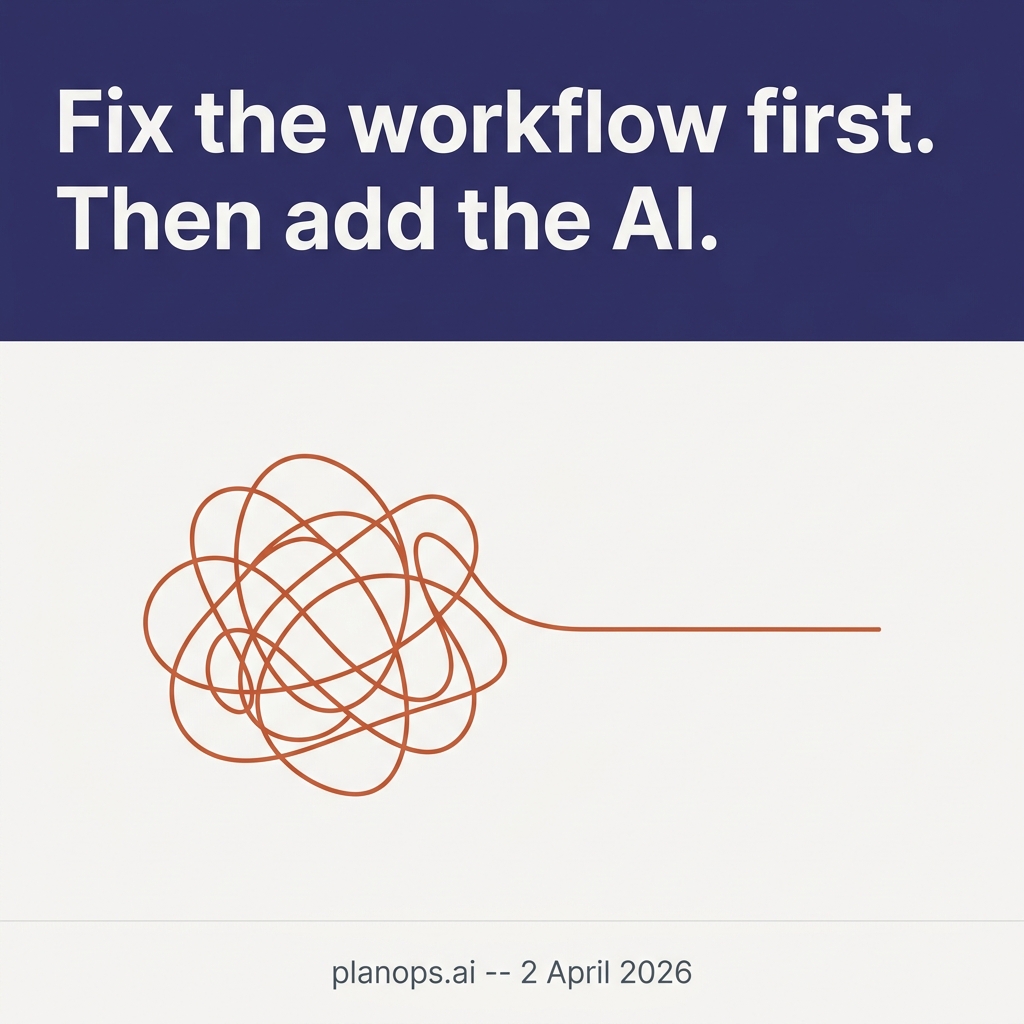
Fix the Workflow First. Then Add the AI.
Bluebeam's research says 84% of AEC firms plan to increase tech investment - but only 11% are fully digital. The UK government has settled its copyright position. And an AI-native platform built entirely by a Chartered Builder is now live for UK SMEs.
AI-assistedPrepared with AI assistance and human editorial review.
Today’s context: This brief covers the latest movements in AI tooling, adoption, and signals for construction teams. Read on for what matters and what to focus on.
UK Focus
AI Adoption Starts With Behaviours, Not Technology
Bluebeam's Steve Smith wrote one of the more direct pieces on UK construction AI this week, and it's worth reading in full. The headline findings from Bluebeam's own research: 84% of AEC firms plan to increase technology investment in 2026. Yet only 11% describe themselves as fully digital across all project phases. AI adoption is strongest in design. It drops sharply on-site.
The argument Smith makes - and it's a good one - is that AI can't rescue a workflow built on broken processes. The Get it Right Initiative puts the cost of avoidable errors in UK construction at somewhere between £10bn and £25bn per year. The root causes are familiar: poor information flow between site and office, inconsistent naming conventions, mixed paper-and-digital handovers. These aren't technology problems. They're behaviour and process problems.
The practical implication is uncomfortable for a lot of firms. You can invest in AI tools and see zero improvement if the underlying workflow is broken. Inconsistent data in means inconsistent decisions out. The technology doesn't fix the culture. The culture has to be ready for the technology.
But, the firms that do have their processes in order - the 11% who are genuinely digital across all phases - are in a very different position. For them, AI is an accelerant, not a solution to a problem they're still diagnosing.
Why it matters
Before signing off on another round of AI investment, audit the basics. How does information move from site to office? Are your naming conventions consistent across teams and disciplines? Where are the paper-to-digital gaps? Those are the questions that determine whether AI investment pays off.
UK Government Holds Its Position on AI and Copyright
On 18 March 2026, the UK government published its long-awaited Report on Copyright and Artificial Intelligence, alongside an Impact Assessment. The short version: no major reform. The government is maintaining the current legal framework for now, declining to introduce new legislation on AI-generated content, training data, or IP ownership.
Agentic AI & Workflows
The Prerequisite Nobody Wants to Talk About
The Archdesk analysis of agentic AI in construction is worth reading alongside the Bluebeam piece above, because both arrive at the same conclusion from different angles.
Agentic AI - systems that plan, reason, and sequence tasks without constant human input - is being applied to construction workflows in five meaningful ways right now: dynamic scheduling that monitors real-time progress and automatically reschedules dependent tasks; change order automation that detects scope creep and routes approvals; predictive procurement that tracks material consumption and triggers just-in-time purchase orders; safety intelligence that analyses incident patterns; and continuous financial oversight that flags margin risks before they become problems.
The critical qualifier from Archdesk's analysis: the AI is only as good as the data feeding it. Firms with fragmented systems - estimating in one tool, scheduling in another, costs in a spreadsheet - will see limited benefit from agentic AI. Data unification isn't a nice-to-have. It's the prerequisite.
This connects directly to the Building Safety Act compliance picture covered in this brief on 31 March. The Golden Thread requires a verifiable, auditable evidence chain. Agentic AI can help build and maintain that chain - but only if your underlying data is structured and connected. Firms that have invested in data infrastructure are now seeing that investment compound. Firms that haven't are facing two problems at once.
Why it matters
Agentic AI is ready for construction workflows. The bottleneck isn't the technology. It's whether your firm's data is in good enough shape to use it.
Wider AI
OpenAI Closes $122bn Raise
OpenAI closed a funding round of $122bn this week - reaching a post-money valuation of $852bn. The company reports 900 million weekly active users for ChatGPT and $2bn in monthly revenue. Strategic partnerships with Amazon, NVIDIA, and Microsoft remain central to its infrastructure plans.
The number is staggering. The more useful signal for construction firms is what it tells you about where investment is concentrating: large-scale AI infrastructure, enterprise AI applications, and the compute required to run increasingly capable models. The firms building on top of these models - including construction-specific tooling - are working with an increasingly capable foundation.
Why it matters
The frontier models that construction AI tools run on are getting better, faster, and cheaper to access. The case for AI investment in your business gets stronger every quarter.
What matters most
- →Before you invest in AI, be honest about your workflows. If your site-to-office information flow is broken, AI will automate the problem, not solve it.
- →The UK copyright position on AI-generated content remains unresolved. If your firm is using AI for design generation or BIM content creation, get legal clarity on IP ownership now.
- →Construction AI's launch proves that domain experts - not software engineers - can build production-quality AI tools. The barrier to entry has dropped. The question is whether you're ready to use what's available.
Ready to put AI to work on your projects?
50 free Intelligence Units. Set up your first project in under 20 minutes. No credit card needed.
Get 50 free Intelligence UnitsGet the brief by email
Daily practical AI insight for construction teams. What changed, why it matters, and what to ignore.
50 free Intelligence Units - automate your programme admin
Why PlanOps publishes this
We help construction teams turn AI into useful work, not noise. Understanding what’s changing in AI is the first step. Making it work on-site is the real difference.
Found this useful? Share it.