Construction AI Brief
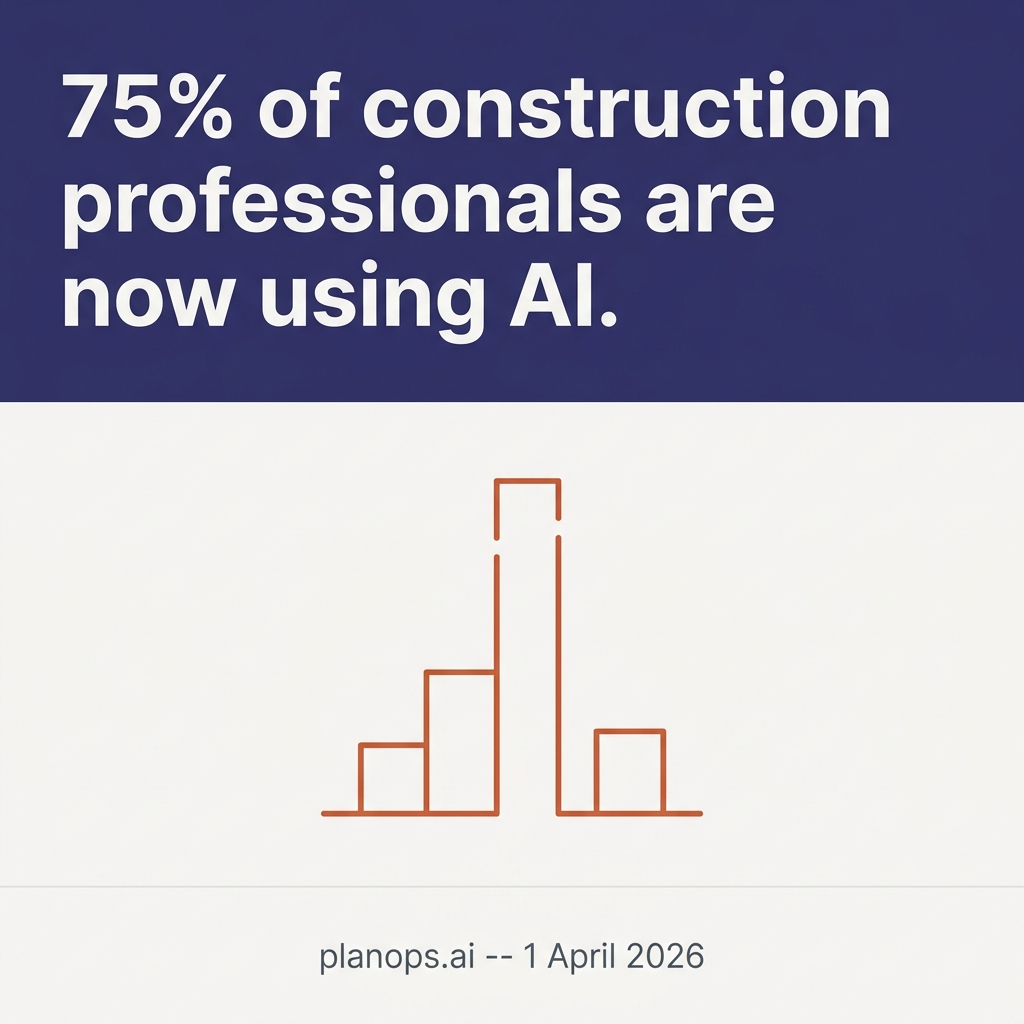
75% of Construction Project Professionals Are Now Using AI
APM data shows AI use in construction has jumped from 15% to 75% in two years. AVEVA and NVIDIA are building digital twin architecture for AI data centres. And the EU AI Act compliance clock is ticking for UK firms.
AI-assistedPrepared with AI assistance and human editorial review.
Today’s context: This brief covers the latest movements in AI tooling, adoption, and signals for construction teams. Read on for what matters and what to focus on.
Adoption & Industry Readiness
AI Use in Construction Has Jumped From 15% to 75% in Two Years
The Association for Project Management (APM) and Censuswide published survey data this week that puts the sharpest number yet on the pace of AI adoption in UK construction. In 2024, 15% of construction project professionals were using AI. Today, that figure is 75%. Ninety-one per cent plan to increase AI investment in 2026.
But the headline adoption figure hides a more uncomfortable story. Only 36% of firms have both a clear AI strategy and tangible results to show for it. Seventy-six per cent of senior leaders say they expect AI to transform their business. Forty-two per cent identify legacy technology as the single biggest barrier to meaningful adoption. That gap - between aspiration and operational deployment - is where most firms are stuck.
The London Build Expo data adds texture. Sixty-eight per cent of firms believe construction is adopting AI faster than other sectors. But when you filter for firms with an actual strategy and documented outcomes, the picture narrows considerably. Using AI is not the same as getting value from it.
The FMB (Federation of Master Builders) published a practical guide this week on five ways SME builders are using AI right now - covering estimating, health and safety documentation, tender preparation, site communications, and customer queries. It's worth reading if you're a smaller firm and want a grounded starting point, not a case study from a tier-one contractor.
Why it matters
The 75% figure means AI adoption in construction has crossed from early-adopter to mainstream. The question for your firm isn't whether to adopt AI anymore. It's whether you're in the 36% that have a strategy and results - or the 64% that don't yet.
UK Infrastructure & Investment
AVEVA and NVIDIA Are Building Digital Twin Architecture for AI Data Centres
London-headquartered AVEVA announced a collaboration with NVIDIA in March 2026 to integrate its engineering and operations software into the NVIDIA Omniverse DSX Blueprint. The joint work is building physical and digital modules for large-scale data centres - what NVIDIA calls "AI Factories" - using lifecycle digital twin architecture.
The significance isn't just the technical partnership. It's the direction it points. The digital twin methodology that AVEVA and the broader UK construction industry have been developing for complex infrastructure projects is now being applied directly to the build-out of AI compute infrastructure. Data centres are some of the most demanding construction projects in the current pipeline: high-specification MEP works, complex power and cooling systems, tight tolerances on commissioning. Digital twin capability that's proven on infrastructure projects transfers directly to this market.
For UK contractors, the pipeline is real. Domestic data centre construction is growing - from the Kao Data campus in Harlow to QTS projects in Northumberland - and the international scale of what's being built (Microsoft's 2.1-gigawatt campus in Texas, covered here on 30 March) shows where that market is heading. Firms with AVEVA or equivalent digital twin capability are well-positioned for it.
Why it matters
The AVEVA x NVIDIA collaboration is a signal that construction-grade digital twin expertise is directly applicable to the AI data centre boom. UK contractors building that capability aren't just serving the traditional built environment - they're positioning for one of the fastest-growing infrastructure markets globally.
Source: AVEVA Press Release - Lifecycle Digital Twin Architecture for AI Factories →
Tools & Platforms
Paper Drawings to 3D Digital Twin: New AI Framework Targets the Retrofit Gap
Researchers have published a framework for automated conversion of paper construction drawings into 3D digital twins - directly addressing one of the biggest barriers to retrofit and net-zero compliance work in the UK. The EurekAlert-published research demonstrates that the process can be automated, rather than requiring manual re-drawing or expensive survey work.
The context matters. The UK has an estimated 5.6 million non-domestic buildings. A significant proportion were built before digital records were standard. Retrofit and net-zero programmes need asset data - floor layouts, structural information, M&E configuration - that often doesn't exist in a usable digital form. Traditional options are expensive: commission a new survey, or pay for manual digitisation. An AI-powered conversion pipeline from paper to digital twin changes that cost equation materially.
The framework is research-grade rather than a product you can deploy today. But the direction it points is clear. Scan-to-BIM tools are already in production (NavLive being the most prominent UK example, as covered on 31 March). The next step is making that pipeline accessible for the vast inventory of buildings that exist only as paper records.
Why it matters
For any firm working on retrofit, refurbishment, or compliance projects in the UK, asset data is the bottleneck. AI-powered drawing-to-digital-twin conversion won't solve that problem overnight - but the capability is getting closer. Worth tracking if your work involves buildings without digital records.
Source: EurekAlert - AI Framework for Paper Drawing to 3D Digital Twin Conversion →
Adoption & Industry Readiness
Architects Shift From "Should We?" to "How Do We?"
An industry survey of nearly 800 architects and designers globally - conducted by Chaos and Architizer - finds that 64% are already experimenting with AI tools in their daily workflows. One in five firms has fully integrated AI across multiple processes. Between 73% and 93% of respondents plan to increase AI use in the coming year.
The survey is notable for what it doesn't find. There's no longer a significant "wait and see" cohort. The conversation in architectural practice has moved from whether to adopt AI to how to integrate it in a way that protects creative authorship and delivers measurable value. Key use cases: concept design acceleration, visualisation, and automating repetitive drawing tasks.
This matters for the construction industry beyond architecture. Architects are typically upstream of the construction process. When design AI is embedded in architectural practice, the models and data that arrive on site are different - richer, faster, more iterated. That has downstream implications for contractors, engineers, and project managers who rely on design-stage outputs.
Why it matters
Design AI adoption is accelerating. Firms downstream of the design process should expect the nature of design deliverables - the models, drawings, and specifications they receive - to change as AI embeds itself in architectural practice.
Source: ArchDaily - What Architects Expect From AI Tools in 2026 →
Government & Policy
EU AI Act Compliance Deadline Is Now Four Months Away
The EU AI Act's general obligations take effect on 2 August 2026. For UK construction firms using AI for safety-critical applications, worker monitoring, or automated decision-making, that deadline is not a distant future concern. It's four months away.
Legal analysis from Browne Jacobson is direct on the implications: standard construction contracts have not yet adapted to AI deployment. That creates liability gaps and commercial risk for firms that haven't audited their AI tools. A firm using an AI system for risk assessment on a higher-risk building, for example, may carry obligations under the Act that aren't reflected in their contract or their supply chain agreements.
The anticipated UK AI Bill has been delayed to mid-2026 at the earliest. That leaves a regulatory gap between the EU Act applying (for firms with EU exposure) and any equivalent UK framework coming into force. Legal teams are navigating it on a case-by-case basis. Construction firms should be doing the same.
The compliance question isn't just about the EU Act. It's about understanding which AI tools in your stack - from site monitoring cameras to risk analysis software to automated scheduling - fall into categories the Act treats as higher-risk. If you don't know the answer, that's where to start.
Why it matters
2 August 2026 is the EU AI Act general obligations date. If your firm has EU exposure and uses AI for safety-critical or monitoring applications, a compliance review is overdue. Don't wait for contract law to catch up.
Source: Browne Jacobson - AI and Emerging Legal Challenges in Construction 2026 →
Wider AI Developments
AI Investment Isn't Stopping for a Recession - KPMG Global Data
KPMG's first quarterly Global AI Pulse Survey covers 20 countries and companies mostly with revenues above $1 billion. The headline finding: 74% of global leaders say AI remains a top investment priority even if a recession hits. Companies plan to invest a weighted global average of $186 million in AI over the next 12 months.
Sixty-four per cent say AI is already delivering meaningful business outcomes. Thirty-two per cent are already deploying and scaling AI agents. A further 27% are orchestrating multiple agents across their business.
The construction and real estate sector breakdown is due in the full report release on 15 April. That will be worth reading. But the macro signal is already clear: AI investment isn't cyclical in the way that construction spend is. Firms cutting AI budgets in a downturn are moving against the tide.
The top concern across all respondents: data security, privacy, and risk. Nearly three in four leaders flagged this. That's the same concern that construction firms deploying AI on safety-critical projects should be building into their governance frameworks now, not retrofitting later.
Why it matters
The KPMG data confirms AI investment is recession-resilient at an enterprise level. The full construction sector breakdown arrives 15 April. The data security concern at the top of the list is a direct parallel for construction firms managing sensitive project data, personnel records, and client information in AI systems.
Wider AI Developments
The Claude Code Source Leak: What It Means Beyond the Headlines
Anthropic's Claude Code CLI had its source code exposed via a source map file in their npm package registry this week - 500,000-plus lines of TypeScript made unexpectedly public. Anthropic moved to contain redistribution via DMCA takedowns. The model weights were not exposed.
The construction implication is indirect but worth noting. What the leak revealed - and what the developer community focused on - is that the performance gap between AI tools isn't primarily about the underlying model. It's about the orchestration layer: persistent memory, autonomous modes, planning and review loops, integration with external systems. The "harness" that wraps the model is where the real engineering leverage sits.
That has a direct parallel for construction firms building AI into their workflows. The value of AI on a project isn't mainly determined by which model you're using. It's determined by how well that model is integrated into your existing data, processes, and decision points. A well-integrated Claude Sonnet 4.6 will outperform a poorly-integrated GPT-5 every time.
The secondary risk from the leak is also instructive. Attackers quickly registered suspicious npm packages to target developers attempting to compile the leaked code. It's a reminder that AI supply chain security isn't just a concern for software developers - any firm integrating AI tools from external vendors needs to understand what dependencies those tools carry.
Why it matters
The Claude Code leak confirmed that AI value is in the integration, not just the model. For construction firms, the practical takeaway is the same: getting AI working well on your projects is an integration and workflow problem, not a model selection problem.
Source: Latent Space / AINews - Claude Code Source Leak Analysis →
What matters most
- →AI adoption in construction has crossed a threshold - 75% using it is no longer an early-adopter story, it's a mainstream one. The question now is whether you're in the 36% with a clear strategy and tangible results.
- →The AVEVA x NVIDIA collaboration shows digital twin expertise built on construction projects is directly transferable to the data centre boom - a growing pipeline for UK firms.
- →The EU AI Act general obligations land on 2 August 2026. If your firm uses AI for worker monitoring, safety-critical decisions, or automated risk assessment, a compliance review is overdue.
Ready to put AI to work on your projects?
50 free Intelligence Units. Set up your first project in under 20 minutes. No credit card needed.
Get 50 free Intelligence UnitsGet the brief by email
Daily practical AI insight for construction teams. What changed, why it matters, and what to ignore.
50 free Intelligence Units - automate your programme admin
Why PlanOps publishes this
We help construction teams turn AI into useful work, not noise. Understanding what’s changing in AI is the first step. Making it work on-site is the real difference.
Found this useful? Share it.