Weekly Roundup
The Data Problem Nobody Wants to Admit - and the Week It Became Unavoidable
Week 13 delivered NavLive's award win, Procore's agentic leap, and the government naming AI a national security priority. But the thread running through all of it was the same: data readiness is the hidden blocker that separates firms that deploy AI well from those that don't.
AI-assistedPrepared with AI assistance and human editorial review.
Today’s context: This brief covers the latest movements in AI tooling, adoption, and signals for construction teams. Read on for what matters and what to focus on.
Data First. Tools Second. The Order Matters.
This week had a story that most construction AI coverage skipped over. It shouldn't have.
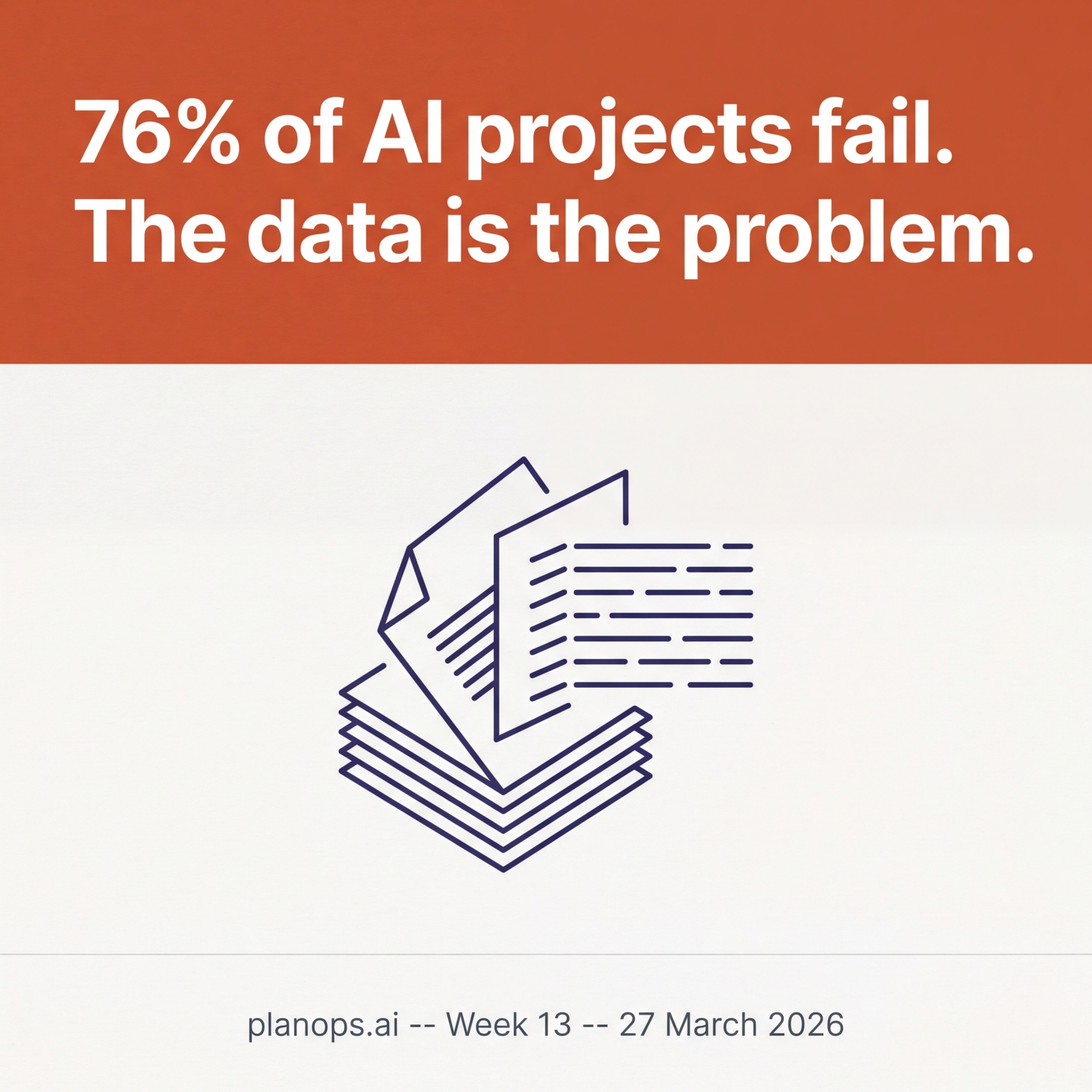
Siemens published something unusually direct for a technology company: an acknowledgement that the biggest problem in industrial AI isn't the tools, it's the data. Gartner backs them up. 60% of AI projects unsupported by AI-ready data will be abandoned by the end of 2026. In manufacturing and construction specifically, the failure rate is already 76.4%.
Read that number again. Not 30%. Not half. Three quarters of industrial AI projects fail - and the culprits are OT/IT integration gaps and data quality problems. Not the AI itself.
This is the context that the rest of this week's news needs to be read in.
NavLive won Best Use of AI at the Digital Construction Awards this week. Their LiDAR scanner generates RICS-grade surveys and full BIM models directly on site, in under 30 minutes. AWW Architects has adopted it specifically for Building Safety Act compliance. Procore went agentic after acquiring Datagrid AI in January, with an Agent Builder now in open beta and a pre-built RFI agent that reportedly cuts resolution time from days to seconds. The UK government named AI infrastructure a formal national security priority in public procurement guidance. These are all real, positive developments.
But they all have the same dependency. They need data to work.
NavLive produces structured spatial data from a scan. That's useful if you have a project environment that can receive, store, and act on it. Procore's agentic RFI tool validates an RFI against the latest drawings, checks the spec, and drafts a response - but only if the drawings are current, the spec is properly uploaded, and the revision history is consistent. AI that navigates your document store is only as good as the document store it navigates.
The Building Safety Act is accelerating AI adoption faster than almost any other force in UK construction right now. It's creating demand for audit trails, documentation quality, and compliance evidence that paper-based and fragmented digital processes simply can't deliver. Firms are reaching for AI tools because the regulatory pressure is real. That's a reasonable response. But if the underlying data isn't clean and consistent, those tools will either fail quietly or produce exactly the hallucinated outputs that Construction Dive warned about earlier this week - confident-sounding, wrong, and legally problematic.
There's a pattern I keep seeing in construction AI adoption stories. A firm deploys a tool, reports impressive early results, and then the case study goes quiet. What often happens next is that the tool runs into the data problem. It surfaces inconsistencies. It fails on edge cases that weren't in the pilot. The ROI calculation gets murkier. And the tool ends up in a corner of the stack, used by a few people who know how to work around its limitations, rather than embedded as a genuine workflow.
The firms that don't hit this wall are the ones that fixed their data before they deployed the tool. Not perfectly - you don't need a pristine data environment to get value from AI. But you need enough consistency, enough structure, and enough quality control that the AI has something reliable to work with.
What does that actually mean in practice?
For most construction firms, it starts with the document register. Are drawings properly named, versioned, and accessible in a single location? Is the spec linked to the relevant drawings? Are RFIs indexed against the documents they reference? These sound like basic hygiene questions, and they are - but they're also the direct enablers of every AI document tool that construction software vendors are selling right now.
The next layer is process consistency. AI tools work best on repeatable tasks. If your RFI process is different on every project because each project manager runs things their own way, an AI agent that learns one version of the workflow will struggle on the next project. Standardisation isn't just about efficiency - it's the foundation that makes AI tools generalisable.
And the third layer is feedback. The practitioners who are getting real value from AI tools are the ones who have built evaluation into their workflows. Not just generating AI outputs and moving on, but checking them, logging errors, and feeding that information back into how the tool is configured and where it's trusted. The over-agentic problem that emerged in technical coverage this week - AI that looks productive but isn't - is fundamentally a feedback problem. Without evaluation, you can't tell the difference between an AI tool that's working and one that's producing confident-sounding noise.
None of this is a reason to hold off on AI adoption. Quite the opposite.
The firms that take data quality seriously now are building a compounding advantage. Every AI tool they deploy will work better because the underlying data is cleaner. Every new tool they add will integrate more easily because their processes are consistent. And the failure rate that's killing three quarters of industrial AI projects will fall dramatically, because the data infrastructure that keeps tripping firms up won't trip them up.
The UK construction industry is at a genuine inflection point. The awards, the agentic platforms, the government procurement signals, the net zero standards - they're all pointing in the same direction. But the firms that will still be talking about these tools in two years, with numbers they can stand behind, are the ones that answered the data question first.
Tools second. Data first. The order matters more than most people are admitting.
Editorial - Week 13
Data First. Tools Second. The Order Matters.
This week had a story that most construction AI coverage skipped over. It shouldn't have.
Siemens published something unusually direct for a technology company: an acknowledgement that the biggest problem in industrial AI isn't the tools, it's the data. Gartner backs them up. 60% of AI projects unsupported by AI-ready data will be abandoned by the end of 2026. In manufacturing and construction specifically, the failure rate is already 76.4%.
Read that number again. Not 30%. Not half. Three quarters of industrial AI projects fail - and the culprits are OT/IT integration gaps and data quality problems. Not the AI itself.
This is the context that the rest of this week's news needs to be read in.
NavLive won Best Use of AI at the Digital Construction Awards this week. Their LiDAR scanner generates RICS-grade surveys and full BIM models directly on site, in under 30 minutes. AWW Architects has adopted it specifically for Building Safety Act compliance. Procore went agentic after acquiring Datagrid AI in January, with an Agent Builder now in open beta and a pre-built RFI agent that reportedly cuts resolution time from days to seconds. The UK government named AI infrastructure a formal national security priority in public procurement guidance. These are all real, positive developments.
But they all have the same dependency. They need data to work.
NavLive produces structured spatial data from a scan. That's useful if you have a project environment that can receive, store, and act on it. Procore's agentic RFI tool validates an RFI against the latest drawings, checks the spec, and drafts a response - but only if the drawings are current, the spec is properly uploaded, and the revision history is consistent. AI that navigates your document store is only as good as the document store it navigates.
The Building Safety Act is accelerating AI adoption faster than almost any other force in UK construction right now. It's creating demand for audit trails, documentation quality, and compliance evidence that paper-based and fragmented digital processes simply can't deliver. Firms are reaching for AI tools because the regulatory pressure is real. That's a reasonable response. But if the underlying data isn't clean and consistent, those tools will either fail quietly or produce exactly the hallucinated outputs that Construction Dive warned about earlier this week - confident-sounding, wrong, and legally problematic.
There's a pattern I keep seeing in construction AI adoption stories. A firm deploys a tool, reports impressive early results, and then the case study goes quiet. What often happens next is that the tool runs into the data problem. It surfaces inconsistencies. It fails on edge cases that weren't in the pilot. The ROI calculation gets murkier. And the tool ends up in a corner of the stack, used by a few people who know how to work around its limitations, rather than embedded as a genuine workflow.
Top Stories This Week
NavLive Wins Best Use of AI at Digital Construction Awards
NavLive, developed from University of Oxford research, won Best Use of AI at the Digital Construction Awards 2026. Their handheld LiDAR scanner generates RICS-grade 1:100 surveys, 2D floorplans and 3D point cloud models on site - no cloud upload required. BW Workplace Experts scanned an eight-storey London bank in under 30 minutes and had a full BIM model within hours.
What makes this more than an award story: AWW Architects has adopted NavLive specifically to meet Building Safety Act compliance requirements. That's a named firm, on live projects, driven by regulatory obligation. NavLive's GBP 4m funding round confirms serious commercial interest beyond the accolade.
The scan-to-BIM market has been building quietly for several years. This award, this adoption case, and this funding are the signals that it's crossed from specialist-contractor territory into mainstream practice.
Why it matters
Scan-to-BIM is ready for mainstream use. The combination of BSA compliance demand, practical award-winning results, and accessible hardware makes this one of the clearest UK market proof points for construction AI this year.
Source: NavLive wins Best Use of AI - Construction Management →
Procore Goes Agentic - Agent Builder Now in Open Beta
After acquiring Datagrid AI in January, Procore has moved fast. Agent Builder is now live in open beta, letting construction teams build custom AI agents via natural language prompts. The pre-built RFI Creation Agent reportedly reduces resolution time from days to seconds. The agents can search across fragmented data sources, validate RFIs, run scope checks, handle prequalification, conduct audits and generate reports - all autonomously.
This is the platform-level shift the industry has been watching for. Not AI features bolted onto existing software, but agentic workflows embedded into the project management layer. The distinction matters in practice. A chatbot that answers questions about your project data is useful. An agent that validates an RFI against the latest drawings, checks the spec, and drafts a response is a fundamentally different proposition.
Also Worth Noting
Skanska Deploys Robotics on Live London Project - Removing Workers from Fatal Risk Zones
Skanska UK CEO Katy Dowding has made the clearest case for construction robotics I've heard from a major contractor: AI and robotics are safety tools, not efficiency tools. Her team has deployed the Schindler Robotic Installation System on the 105 Victoria Street office build in London, removing workers from elevator installation tasks. She's explicit about the ambition - using AI and robotics to remove humans from the most dangerous positions on site: electrical work, heavy lifting, working at height, people-plant interface.
The UK construction sector averages 35-50 fatalities per year. Electrical accidents have risen 75% in recent years. The robotics story and the safety story are the same story.
Why it matters
Skanska's deployment isn't a pilot - it's a safety decision on a live London project. The framing from Dowding is important: AI replaces the most dangerous tasks, not the most skilled workers.
Autodesk and Procore Bridge via Model Context Protocol - Multi-Platform AI Is Here
AMC Bridge has built an MCP Connector that lets AI agents work across both Autodesk Platform Services and Procore simultaneously. Natural language queries can now span project documents, drawings and cost data across both systems, replacing point-to-point integrations. The Model Context Protocol is becoming the standard plumbing for multi-tool AI workflows in construction - and this demonstration is the first time the two dominant construction platforms have been bridged this way.
Combined with Procore's Agent Builder (above), this is the week that multi-system AI agents went from concept to deployable technology for UK construction teams.
Why it matters
Construction teams running both Autodesk and Procore can now build agents that span both platforms. The integration overhead that has always made multi-system AI impractical is starting to disappear.
What matters most
- →Before asking "which AI tool?" ask "is our data AI-ready?" - a 76% failure rate tells you the order of operations matters
- →UK construction AI is now being driven by regulatory pressure as much as productivity - BSA compliance, net zero standards, and government procurement rules are all pointing the same direction
- →The AI data centre boom is reshaping UK construction labour markets - SME housebuilders competing for the same MEP trades as hyperscale data centre projects should be factoring this into workforce planning now
Ready to put AI to work on your projects?
50 free Intelligence Units. Set up your first project in under 20 minutes. No credit card needed.
Get 50 free Intelligence UnitsGet the brief by email
Daily practical AI insight for construction teams. What changed, why it matters, and what to ignore.
50 free Intelligence Units - automate your programme admin
Why PlanOps publishes this
We help construction teams turn AI into useful work, not noise. Understanding what’s changing in AI is the first step. Making it work on-site is the real difference.
Related issues
government-policyindustry-readiness
Construction AI: the Regulator lets you split the job in two, and the money buys the excavator not the paperwork
The Building Safety Regulator has extended staged Gateway 2 applications to single-tower higher-risk buildings, so you can get groundworks approved and out of the ground while the superstructure design catches up. On the same stage, SoftBank is reported to be weighing a deal north of $500m for a Swiss firm that turns ordinary excavators autonomous, a reminder the AI money is now chasing the steel as well as the spreadsheets.
- • "The Building Safety Regulator has extended staged Gateway 2 applications to single-tower higher-risk buildings (at least seven storeys or 18m), letting firms split groundworks and foundations from the superstructure; reported across the trade press in the week to 12 August 2026, with interim BSR chief Charlie Pugsley calling it potentially 'key' to speeding approvals."
- • "SoftBank is reported by Bloomberg (early August 2026) to be weighing a deal valuing Zurich's Gravis Robotics at more than $500m; the ETH-spinout retrofits standard excavators with LiDAR, cameras, GNSS and hydraulic sensors so they trench, grade and manage stockpiles on their own. Deal not finalised (reported)."
Found this useful? Share it.