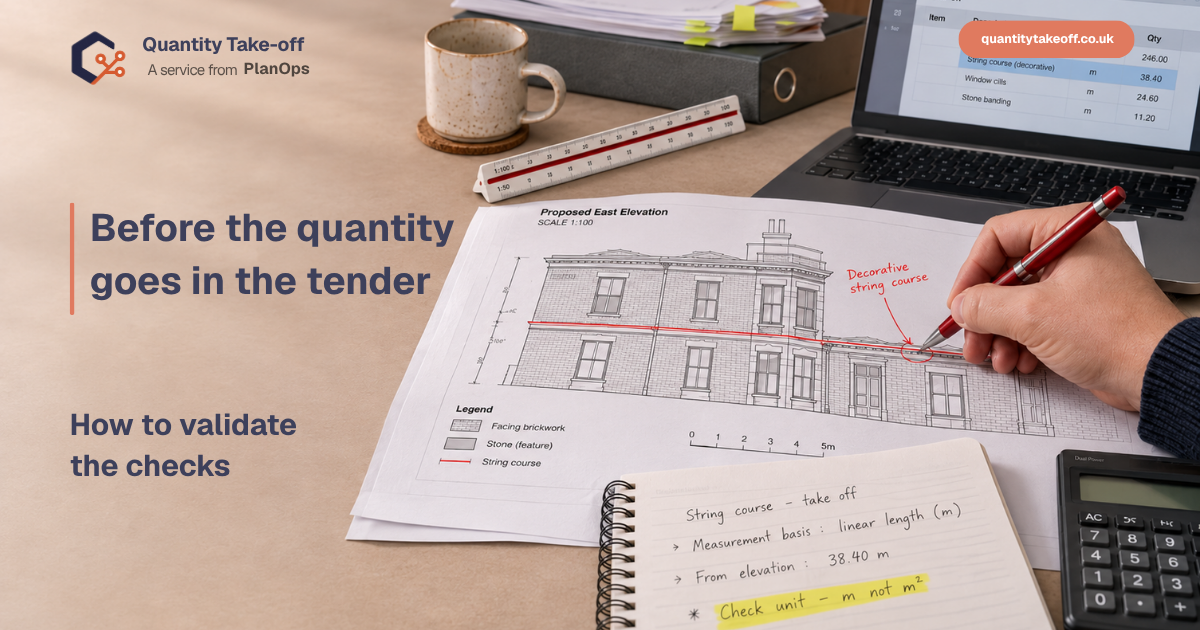
In one of our November take-off tests, the words “string course” selected length as the measurement method. When we used the full description from the drawing legend, the software selected area for the same feature. The extra detail was the material and finish. A person reading the drawing would have understood what those words were doing there. They described the string course. They didn’t change what we wanted to measure.
We could reproduce the error. An ordinary piece of code looked along the description and used the last term it recognised to choose a measurement method. The word “finish” took precedence. Here is what the saved assessments recorded on 12 November.
| Description assessed | Morning method | Evening method |
|---|---|---|
| TYPE 3 – String Course; Material – Arch Masonry; Colour – Bathstone; Finish – Shot blasted; Size – 440 × 215 × 100 mm | Area (m²) | Length (m) |
The legend wording comes from the saved development-test responses, with spacing and punctuation normalised. The earlier assessment recorded its reason: “Taken off by area: a finish is a surface item. The profile had said length.” The evening assessment retained the full description and selected length. Both string-course lines were still marked unresolved. Neither quantity had been accepted.
This happened during development. The commercial consequence is worth thinking through. Imagine an estimator picking up that line with a supplier’s rate per metre. With the drawing and the rate in front of them, they have a fair chance of spotting the mismatch. A commercial manager reviewing the package total on tender day would have very little chance. By then the unit may have disappeared from everything they see.
For a separate illustration, our worked take-off example uses an invented drawing and a hand-written schedule to show how counts and candidate measurements appear to the reviewer.
At Digital Construction North I asked what record we should keep when AI helps someone reach a project decision. The string course puts a finer point on it. Where in that chain could someone have made a useful check, and what would they have needed in front of them?
What the professions already expect
For a chartered surveying practice, part of the answer is already in force. The RICS professional standard on AI took effect on 9 March 2026. It applies to RICS members and regulated firms where AI use has a material impact on the surveying service they deliver. Section 4.2 requires a written judgement about the reliability of an output that will have that impact. A named, appropriately qualified surveyor makes or supervises the assessment. The record needs to explain concerns about the result and whether it can reasonably be used for the intended purpose. RICS provides for randomised sampling in automated or high-volume work. [1]
There is a client on the other side of that judgement. Where the standard applies, the client must be told in writing, in advance, when AI will be used and for what purpose. For a quantity surveying practice preparing a cost plan, that conversation belongs at the point of agreeing how the work will be done. It is rather late to raise it when the client queries a figure. [1]
CIBSE’s position statement of 9 November speaks to building services engineers. Its published account says engineers remain responsible for the work they produce and calls for qualified professionals to scrutinise and verify AI outputs. It sets out the institution’s position. The particular written assessment described above comes from RICS. The Law Society makes a related point to solicitors in its practice note, updated in November 2026. The duty to supervise the work continues when someone uses AI to help prepare it. [2, 3]
There is also a statutory question for those carrying out design or building work in England. Regulation 11F of the Building Regulations 2010 addresses the competence of the individual and the capability of the organisation to carry out the work and fulfil the relevant duties. For an individual, that includes skills, knowledge, experience and behaviours. The regulation also provides for trainees working under adequate supervision. Its subject is competence to do the work. A course in using a particular tool would tell me very little about someone’s ability to judge whether a proposed design meets the relevant requirements. [4]
When does it matter on a job?
An SME contractor deciding how to use AI may sit outside the RICS standard. I would start with one job and ask the team to identify a decision that could go differently if the output were wrong or something important were missing. That is the sense in which I use consequential. It is a working test I would use with a project team.
Take two uses of the same drawing tool. An estimator wants a list of elevations worth opening. A missed elevation costs some time if they still work through the drawing register. Now suppose that list defines which elevations go to a subcontractor for pricing. The omission can take part of the works out of the enquiry. The software, the drawings and the person at the keyboard could all be the same. What changed was the instruction to the next person.
Commercial approval limits give a team somewhere to start. I would also ask how often an error could repeat, who could spot it and how far the job would have progressed by then. A modest error repeated across every house type deserves attention. So does a missed notice date that could affect entitlement, an omitted safety control or a change to a design assumption. Waiting for someone to attach a pound value would leave several of those decisions unchecked.
A one-page assessment for the team
I would put this alongside the existing tender or design review. The entries below illustrate how a contractor could use it for the string course.
| What to record | Example entry |
|---|---|
| Intended use and decision | Measure the string course for the masonry enquiry. The quantity will form part of the subcontractor’s pricing schedule. |
| Who owns the check? | Enter the estimator’s name. The commercial manager resolves any disputed basis before the enquiry goes out. |
| Evidence and review method | Identify the elevation revision and legend entry. Mark the runs included. Compare the measured length and unit with the package scope and the basis of the supplier’s rate. |
| What happens if the check fails? | Hold the line for clarification. Check other descriptions that use the same material or finish wording. |
| What goes forward? | Record the agreed quantity, unit, exclusions, reviewer and date against the issued schedule. Reopen the line if the drawing revision or pricing basis changes. |
I would be quite content for that record to sit in the estimator’s existing workbook. Months later, when a subcontractor asks whether the returns were included, the person answering should be able to open the marked elevation, see the extent that was priced and give them an answer.
Sources
- RICS, Responsible use of artificial intelligence in surveying practice, first edition, particularly sections 1.2, 4.2 and 4.3.
- CIBSE, announcement of its position statement on responsible AI use in building engineering, 9 November 2026.
- The Law Society of England and Wales, Using artificial intelligence in legal practice, updated 23 November 2026.
- Building Regulations 2010, regulation 11F. See also the Building Safety Regulator’s guidance for England.